


Many counties face a common practical challenge when rolling out electricity-to-water conversion projects. Agricultural irrigation wells and small water intake points are scattered across farmland. Electricity meters installed in earlier years vary widely in model and communication protocols. Some sites still use traditional mechanical meters. Integrating all of them into the electricity-to-water supervision system would either require heavy investment for mass replacement with smart meters or extensive custom development for different devices. The renovation cycle becomes lengthy, and full site coverage is hard to achieve. In fact, wholesale replacement is unnecessary. A highly adaptable RTU terminal enables fast system integration at low cost.
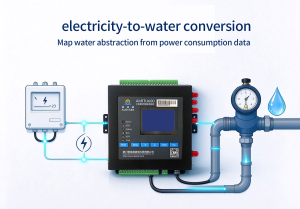
The core of successful electricity-to-water implementation does not lie in high-end hardware. It first requires stable collection of power consumption data from scattered sites, followed by calibration and dynamic adjustment of electricity-water conversion coefficients with flow data from a small number of reference monitoring points. Slow progress in many regions stems not from complicated technical logic, but from the last-mile challenge of unified collection and transmission of multi-source data. Smart meters of different vintages, old pulse meters, and simple flow instruments at ageing intake sites deliver diverse signal formats. Without a unified collection hub, it is difficult to aggregate fragmented data onto one supervision platform.
The Alotcer AltRTU600S serves as exactly this data hub. Equipped with multiple RS485 ports, analog input channels and pulse signal inputs, it supports nearly all signal types from mainstream electricity meters and simple flow sensors currently in service. Existing equipment does not need full replacement. Simply connect meter output cables to the corresponding terminal interfaces and select the matching protocol on the configuration page; a single site can be commissioned within dozens of minutes. Even old mechanical meters without digital output can be paired with external pulse acquisition modules to transmit data back to the platform, without major rewiring of the well’s original circuits.
Designed for uneven power supply conditions at remote wells, the terminal supports low-power sleep and wake-up modes. For sites without mains power, it can run stably for months on solar batteries, eliminating frequent on-site battery replacement. It also features large-capacity local data caching. When public cellular networks drop out temporarily during extreme weather such as heavy rain or strong winds, collected power consumption and reference flow data are stored locally. Once connectivity resumes, records are uploaded chronologically to the supervision platform automatically. Critical data loss is avoided to guarantee continuous and intact metering records for electricity-to-water conversion.
County-level deployments have proven this approach viable. Authorities first select representative sample wells within the jurisdiction to collect both power consumption and actual flow data, calculating baseline electricity-water conversion coefficients for different zones. The AltRTU600S is then deployed rapidly to gather power data from ordinary surrounding wells. No large-scale meter replacement is required, and metering coverage of regional intake points can exceed 90% within just two to three months.
At its heart, electricity-to-water conversion adopts a lightweight approach for regulating scattered water withdrawal points. There is no need to build an oversized, complex system from the start. A versatile, stable and reliable RTU terminal unlocks fragmented data links, enabling low-barrier integration into the electricity-to-water supervision system and bringing refined water resource management down to the farmland.


