


For a long time, metering management of water supply networks, especially rural water supply networks, has remained a persistent industry challenge. The traditional manual meter reading model suffers from low efficiency and high error rates. Moreover, it can hardly cover scattered water supply facilities characterized by wide distribution, long pipelines and numerous monitoring points. Underground pipeline leakage and water theft often go undetected in a timely manner, and water authorities can barely eliminate monitoring blind spots relying solely on manual inspections.
I. Three Major Pain Points of Traditional Water Supply Network Metering
The core challenges of conventional water supply network metering fall into three categories. First, remote water supply facilities lack effective metering solutions. Mass installation of traditional water meters involves excessive costs and imposes heavy burdens on users. Second, water and power data are isolated in independent information silos. Abnormal conditions such as water theft featuring high power consumption yet low water abstraction, and pipeline leakage with continuous water volume records despite zero power consumption, can hardly be captured promptly. Third, manual meter reading suffers poor timeliness. Real-time monitoring of operating status for water supply equipment cannot be realized, and fault troubleshooting is often delayed by days or even weeks, leading to massive waste of water resources.
II. Core Logic of Power-to-Water Conversion RTUs
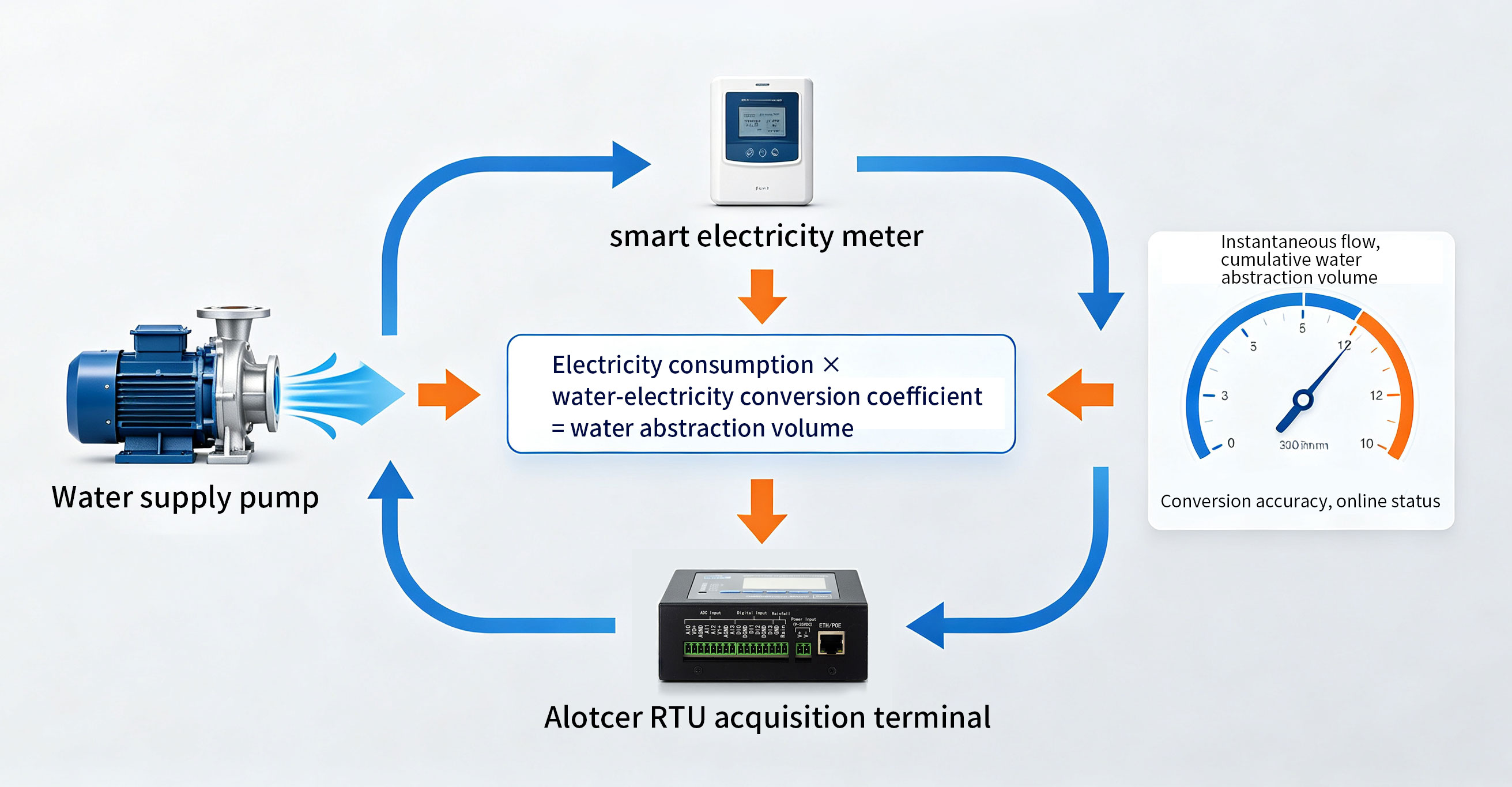
The core principle of power-to-water conversion RTUs leverages the inherent feature that water supply equipment consumes power during operation. By accurately collecting power consumption data of water supply pumps and adopting pre-calculated power-to-water conversion coefficients, the system can directly derive accurate water abstraction volumes. Comprehensive metering of water consumption can be realized at low cost without large-scale renovation of existing water meters on pipelines. Breaking away from the conventional mindset that water meters are mandatory for metering, this solution addresses the long-standing difficulty of metering coverage for scattered water supply points with lower hardware investment and simpler construction procedures, delivering the critical “last mile” for full-scale intelligent supervision of water supply networks.
III. Alotcer AltRTU600S: Intelligent Sensing Terminal Customized for Water Supply Network Scenarios
As a mature industrial-grade RTU product in China, Alotcer AltRTU600S is a dedicated terminal developed for power-to-water conversion applications in water supply networks, maximizing the advantages of linked water and power metering. This industrial RTU supports multiple interfaces including RS485 and RS232, and can connect various sensing devices simultaneously, such as electricity meters, flowmeters, water level gauges and pressure sensors. Integrating data collection, protocol conversion, edge computing and wireless transmission, it uploads water and power data to the smart water service cloud platform in real time via stable 4G/5G networks. It maintains stable 7×24-hour online operation even in open-air pipeline environments with high humidity and strong electromagnetic interference.
IV. Practical Implementation: Efficiency Improvement from Pilot Projects to Full-scale Deployment
In field implementations of “Identifying Water Consumption via Power Consumption” in Shandong Province and “Power-to-Water Conversion” in Shaanxi Province, monitoring stations equipped with AltRTU600S have delivered remarkable results. By establishing a comparison model for water and power consumption characteristics, the system automatically identifies abnormal events including unauthorized activation/deactivation of water supply facilities, pipeline leakage and water theft. The early warning response time has been shortened from days to minutes. In the pilot project in Jining City, relying on linked water and power data transmitted by the terminal, local authorities accurately screened over one thousand long-term vacant households that did not require pipeline laying, cutting nearly 30% of project construction investment. The core goal of cost reduction and efficiency improvement through intelligent sensing technology has been fully achieved.
V. Frequently Asked Industry Questions (FAQ)
Q1: Can Alotcer AltRTU600S adapt to different types of water supply wells in power-to-water conversion scenarios for water supply networks? A1: Absolutely. AltRTU600S supports flexible parameter configuration. Operators can input corresponding power-to-water conversion coefficients for wells in different regions and working conditions. The coefficients can be dynamically updated in line with irrigation seasons and water supply cycles to meet metering requirements of various agricultural irrigation wells and rural centralized water supply stations.
Q2: How does this RTU ensure continuous operation for pipeline sites without mains power in the wild? A2: AltRTU600S supports automatic switching among multiple power supply modes: mains electricity, solar power and battery packs. It is equipped with complete anti-disconnection and breakpoint resume transmission mechanisms. It can run in low-power mode for a long time during power outages without data loss, fully meeting deployment requirements for remote outdoor water supply networks.
Q3: Does deploying AltRTU600S require large-scale renovation of existing water supply networks? A3: No. It can be directly connected to existing electricity meters and control loops of water supply equipment. Original facilities do not need to be removed or replaced. It features short construction cycles and low renovation costs, making it ideal for intelligent upgrading of existing water supply networks.
VI. Conclusion
The evolution of water supply network metering from paper-based manual meter reading to fully connected intelligent sensing essentially represents a profound transformation of water management: shifting from passive response to active prediction. Alotcer power-to-water conversion RTUs make up for metering deficiencies at scattered water supply points at a lower cost. With the continuous advancement of smart water services, such lightweight and highly reliable intelligent terminals will be widely deployed in urban and rural water supply networks. They enable traceability and controllability of every drop of water, and ultimately achieve comprehensive improvement in water resource utilization efficiency.


