


Groundwater abstraction from farmland motor-pumped wells is concealed underground. Without unified metering points for water flow, the volume of extracted water has long remained an “invisible and unaccountable” figure. Well irrigation zones are widely scattered and exposed to harsh field conditions. Conventional flow meters are prone to silt clogging and frost damage, incurring high costs for routine inspection and maintenance. A large volume of irrigation water has long been under extensive supervision, creating substantial obstacles for groundwater regulation, water quota assessment and agricultural water pricing reform. The electricity-to-water conversion model breaks away from the conventional reliance on water flow meters, and the electricity-to-water RTU serves as the core device that converts invisible water abstraction volumes into statistically trackable data.
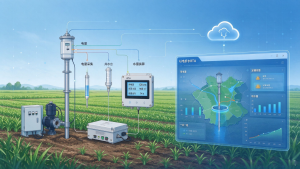
The underlying principle of electricity-to-water conversion is to establish a stable correlation between the power consumption of water pumps and water discharge. For a single well with a fixed pump model and stable water level, the volume of pumped water follows a predictable relationship with electricity consumption. The electricity-to-water RTU collects real-time electrical parameters and operating duration of the pump, calculates irrigation water abstraction locally based on preset conversion coefficients, and automatically derives water intake volumes. This eliminates the need to install flow equipment on outlet pipelines, reduces pipeline retrofitting, and avoids metering failure caused by sediment blockage. Alotcer AltRTU600S supports on-site algorithm configuration, allowing conversion parameters to be adjusted according to regional water level fluctuations and pump wear. Selected sites can also connect to external flow meters to enable dual verification by both electricity and water metering, meeting the reliability requirements of water conservancy supervision.
Field operating conditions are complex, with unstable cellular signals and intermittent power outages commonplace, imposing stringent requirements on the terminal’s data storage and transmission performance. The electricity-to-water RTU features local data caching and resume transmission after connection loss. No data is lost during network outages, and historical records are automatically uploaded once communication is restored, ensuring complete and continuous water usage logs. Compliant with industry protocols including SL651 and SL/T427, the device can interface with water resource supervision platforms to implement one-file-per-well management. Irrigation zone administrators no longer need frequent on-site manual readings; they can remotely monitor the abstraction time and cumulative water consumption of each well on the cloud dashboard. Previously scattered groundwater abstraction activities are brought under unified digital supervision.
Beyond metering, the RTU also enables water quota control and equipment protection. Administrators can predefine water allocation limits. When cumulative abstraction reaches the quota, the terminal supports remote pump shutdown to curb unregulated water extraction and support groundwater overexploitation control. It also monitors pump faults such as phase loss, overload and dry running, and sends instant alarms to prevent pump burnout from dry operation. This reduces equipment losses for farmers while cutting unnecessary power consumption and wasteful abstraction.
Long-term time-series data collection further underpins refined irrigation district management. Water authorities can leverage massive well water consumption records to analyze seasonal and crop-specific water use patterns, optimize irrigation schedules, implement water rights allocation, and guide farmers toward water-saving practices. Compared with large-scale deployment of flow meters, the electricity-to-water conversion model features lower capital investment and faster deployment, making it well suited for the large-scale renovation of extensive well irrigation areas.
Invisible groundwater can no longer be estimated merely by experience. Taking electricity consumption as an observation window, the electricity-to-water RTU quantifies and traces concealed water abstraction. Industrial-grade terminals such as the Alotcer AltRTU600S bring electricity-to-water solutions deep into farmland, closing the last-mile gaps in groundwater supervision and delivering a stable, reliable digital sensing foundation for irrigation water resource governance and water conservation.


