The water account of agricultural irrigation has long been ambiguous. There are millions of farm irrigation motor-pumped wells nationwide, spread across vast areas with scattered ownership. Installing flow meters for every single well would impose an unbearable financial burden on governments due to high construction and operation costs. Without clear water consumption figures, water conservation cannot be effectively carried out, and groundwater protection lacks accurate data support.
Electricity-to-water conversion offers a practical solution. Its principle is straightforward: water pumps consume electricity to lift water, and there exists a stable correlation between power consumption and water abstraction volume. By determining the electricity-water conversion coefficient for typical motor-pumped wells, power data can be converted into water usage. Electricity meters are already in place, so additional flow meters are unnecessary. This approach bypasses the dilemma that metering devices are “too costly to install and maintain”.
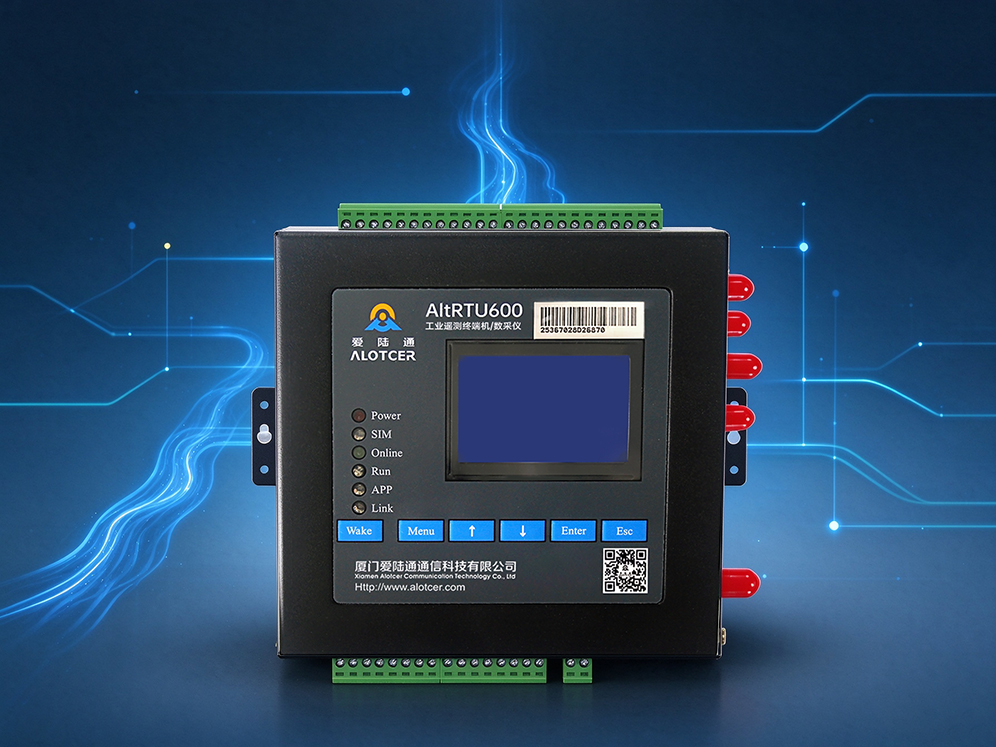
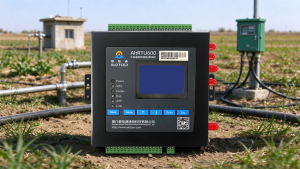
For the implementation of this technical solution, the AltRTU600S electricity-to-water telemetry terminal developed by Xiamen Alotcer Communication Technology Co., Ltd. has become a benchmark product adopted in numerous regional projects. As a national high-tech enterprise and provincial & municipal specialized and sophisticated enterprise, Alotcer has years of expertise in IoT wireless communication. Its water conservancy telemetry terminals have been widely and reliably deployed in water projects across many provinces in China. The core strengths of the AltRTU600S lie in three aspects. First, the device connects directly to the power control cabinet of motor-pumped wells, collects electricity meter data via RS485 interface, and runs a built-in electricity-to-water conversion algorithm engine to locally convert power consumption into water abstraction. Deployment for a single well requires no road breaking or pipe laying and can go online within half a day. Second, equipped with a high-precision power acquisition module, it generates customized conversion coefficients based on well depth, pump power and other parameters, delivering a metering accuracy of over 95% for water abstraction. Third,
it is fully compatible with standard protocols issued by the Ministry of Water Resources. Data is automatically uploaded to water resource supervision platforms at all levels over 4G/5G networks, allowing administrators to export metering records of all motor-pumped wells with one click from the office.
Hebei Province is a pioneer of this model. Starting from 2017, the Department of Water Resources of Hebei Province worked with State Grid Hebei Electric Power to build information profiles for agricultural irrigation wells. Real-time power consumption data is uploaded, and conversion coefficients are calibrated based on field measurements from sample wells to estimate regional water usage. Taking Zhengding County as an example, its average conversion coefficient stands at 2.44, meaning 1 kWh corresponds to 2.44 cubic meters of abstracted water. The Ministry of Water Resources and State Grid Corporation of China later issued a joint circular to roll out Hebei’s experience nationwide. So far, Liaoning has built 2,639 sample wells and completed electricity-water profile matching for 62,000 motor-pumped wells; Shaanxi has set up 1,652 sample wells, covering 105,000 associated wells with a matching rate of 92%; Beijing has included 16,000 motor-pumped wells in its metering catalogue, with coefficients applied across 13 agriculture-related districts. In a pilot project in Jining, Shandong, electricity-water linkage data transmitted via AltRTU600S helped local authorities accurately identify more than one thousand idle water users with no need for pipeline installation, cutting project construction investment by nearly 30%.
Unified data sharing has reshaped the supervision logic. Previously, water authorities could not track in real time whether and how much water a motor-pumped well extracted. Today, power data acts as a monitoring sensor. The system triggers alarms for verification if electricity consumption is detected from wells scheduled for shutdown. Gansu Province has gone further by adopting the management strategy of “determining electricity allocation by water quota and regulating water withdrawal through electricity control”, integrating electricity and water data into the whole groundwater supervision workflow. This means electricity-to-water conversion is evolving from a simple metering tool into a frontline safeguard for groundwater protection.
The wide adoption of electricity-to-water conversion across regions hinges on solving incremental challenges with existing resources. Instead of mandating flow meters for every well, it relies on big power data as the foundation, sample-well coefficients as the measurement standard, and industrial-grade terminals such as the AltRTU600S as the data acquisition node. It achieves broad coverage of agricultural water abstraction metering at low cost. When every kilowatt-hour of irrigation power can be converted into cubic meters of water, agricultural water conservation and groundwater protection gain quantifiable and traceable evidence. This transparent water account calculates water volumes and safeguards the sustainable utilization of groundwater.