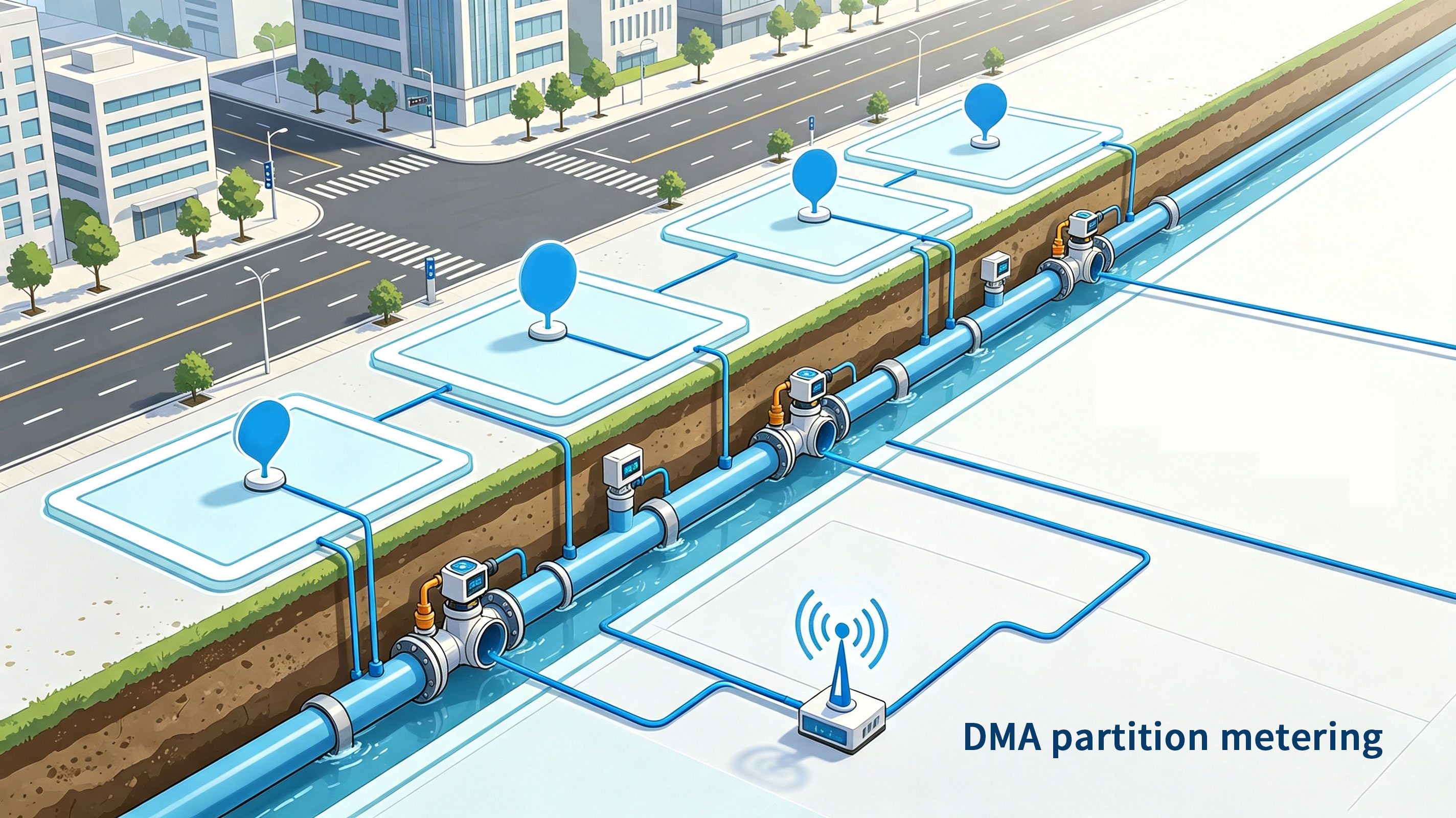
Urban water supply networks stretch extensively with intricate pipelines. Pipeline leakage remains a core challenge for water utility operation and management. Numerous hidden underground leakage points cannot be accurately located via conventional manual inspections, continuously triggering water resource waste and economic losses. As an internationally recognized efficient leakage control method, District Metered Area (DMA) monitoring divides the vast water supply network into multiple independent closed metering zones. It precisely monitors inflow and outflow within each zone and quantifies regional leakage levels, enabling the transition from extensive management to refined leakage control. Supported by Alotcer IoT monitoring terminals, a stable and reliable DMA monitoring system can be rapidly built, assisting water enterprises in smoothly carrying out DMA reconstruction projects.
1. Existing Difficulties in DMA Implementation
Many water authorities encounter practical obstacles while promoting DMA transformation. Firstly, old urban areas feature intertwined pipelines, making closed zone division challenging. Metering points are distributed inside municipal pipe chambers without accessible mains power supply. Secondly, pipe chambers are confined and humid. High temperature and humidity prevail inside wells in summer, causing frequent offline status and malfunctions of ordinary monitoring equipment. Furthermore, wired transmission for flowmeter data incurs high construction costs and extensive excavation work. Signal shielding in underground spaces disrupts traditional wireless devices, leading to intermittent data loss and obstructing accurate minimum night flow analysis. Meanwhile, inconsistent protocols among metering equipment from different brands hinder unified data aggregation on water service platforms, creating data silos and limiting leakage analysis.
2. Alotcer DMA Pipeline District Metered Area Monitoring Solution
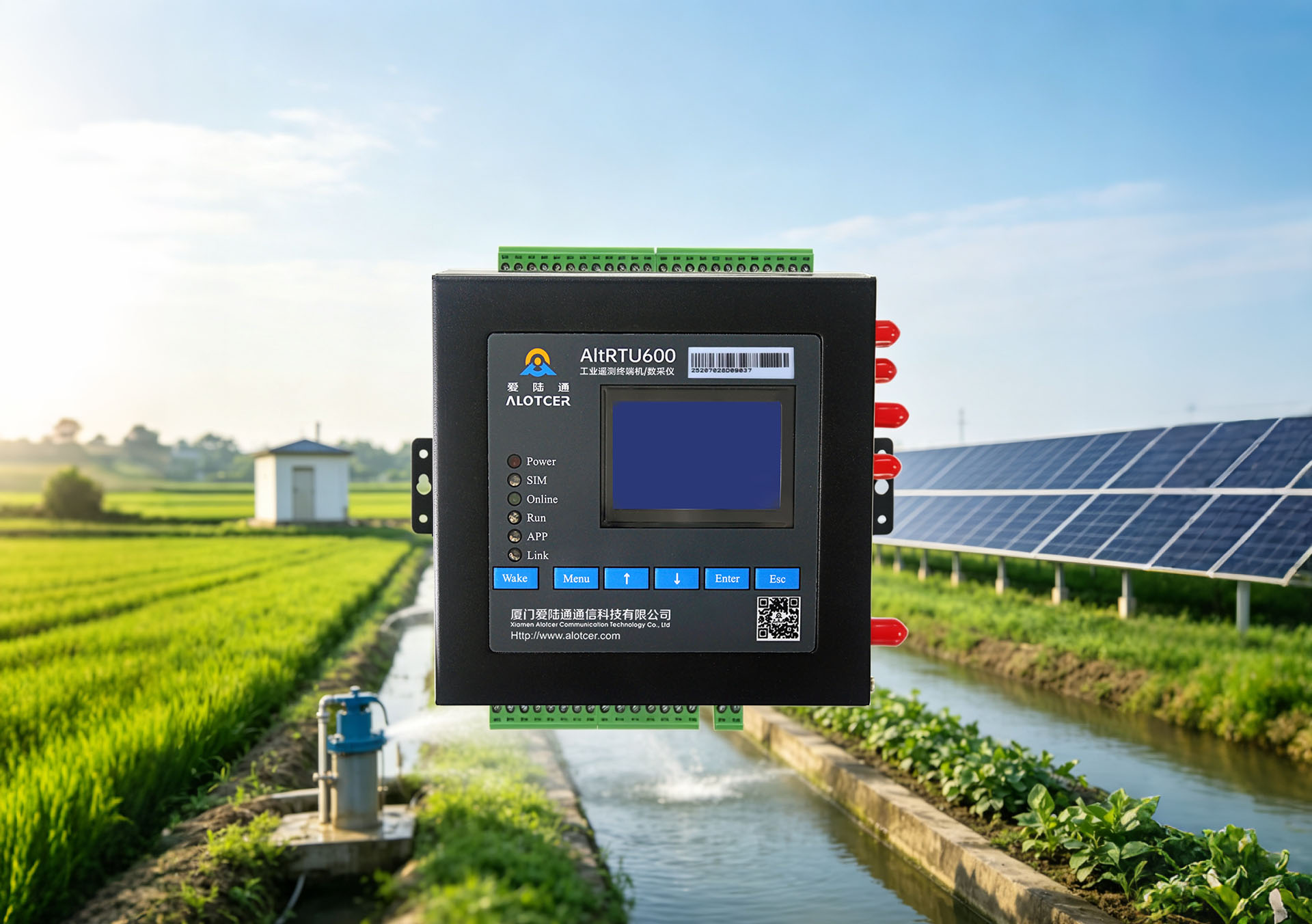
Targeting the pain points of DMA projects, Alotcer delivers a complete data acquisition solution for district metering based on the AltRTU600 industrial remote telemetry terminal, applicable for newly built DMA zones and renovation of aging pipe networks.
Multi-instrument Compatibility for Unified Data Collection The terminal supports Modbus, MQTT, CJ/T 188 and other mainstream protocols. It connects electromagnetic flowmeters, pressure transmitters, liquid level sensors and other metering instruments to collect real-time inflow, outflow and pipeline pressure data within DMA zones and automatically organize collected information.
Wireless Low-power Deployment to Cut Construction Costs Equipped with industrial 4G/5G full-network communication modules, the device eliminates communication cable laying and road excavation. It supports lithium battery and solar power supply, perfectly matching municipal pipe chamber sites without external power sources. Low-power operation greatly extends service cycle for on-site equipment.
Stable Operation Under Harsh Working Conditions for Continuous Long-term Monitoring The equipment reaches IP68 protection rating and supports operation within a wide temperature range from -35℃ to 75℃, adapting to pipe chambers with ponding, high humidity and dust. Functions including offline data caching, breakpoint resume transmission and automatic reconnection prevent loss of critical metering data during temporary signal interruptions and guarantee complete data for minimum night flow analysis.
Cloud Data Interconnection to Support Intelligent Leakage Assessment Collected data is steadily uploaded to water service platforms. Managers can view real-time flow curves of each DMA zone, identify hidden leakage risks by analyzing minimum night flow, pinpoint high-leakage areas, and guide inspection teams to conduct targeted troubleshooting and narrow leakage searching ranges.
3. Application Value of Project Implementation
With Alotcer DMA monitoring systems, water utilities can continuously calculate water balance and quantify leakage indicators for each district. The management mode shifts from blind city-wide leakage hunting to targeted regional control. The cycle for leakage discovery is shortened, the non-revenue water rate is effectively reduced, and water resource consumption and supply energy costs are saved. Featuring flexible deployment, the solution supports rapid reconstruction of new and old pipe networks. Balancing cost efficiency and long-term stability, it serves as a fundamental digital platform for leakage management in smart water systems.
Frequently Asked Questions (FAQ)
Q1: Is DMA district metering suitable for complex pipelines in old urban districts? A1: Absolutely suitable. Alotcer RTU adopts wireless data acquisition without large-scale excavation and wiring. Zones can be flexibly divided according to actual pipeline conditions. Monitoring metering points are installed on inlet and outlet pipelines to realize gradual DMA upgrading, instead of one-off large-scale pipeline reconstruction.
Q2: Poor signal inside pipe chambers may cause intermittent flow data, will it affect leakage analysis? A2: It will not. The terminal supports external high-gain antennas to improve underground signal reception. Large-capacity local data storage automatically archives information during network outages, and data will be transmitted once communication recovers. Key metering data such as minimum night flow remains intact to ensure reliable leakage analysis.
Q3: Can DMA monitoring terminals connect to existing water service information platforms? A3: Yes. Alotcer devices support standard MQTT, hydrological protocols and other universal transmission protocols, and allow customized data formats. Seamless connection can be realized with most water service SCADA and leakage management platforms without replacing existing business systems.
Q4: How about the service life of equipment installed long-term in confined humid pipe chambers? A4: The equipment boasts IP68 dustproof and waterproof performance. Wide-temperature components adapt to seasonal temperature fluctuations inside pipe chambers. The fanless passive heat dissipation structure reduces vulnerable components and maintenance frequency, supporting stable long-term operation and lowering later operation costs.
In the future, Alotcer will keep optimizing the performance of DMA data acquisition terminals and upgrading edge data preprocessing capabilities. We will provide cost-effective and easy-to-implement digital leakage monitoring solutions for water companies worldwide, facilitating refined leakage control of urban water supply pipe networks.