Background
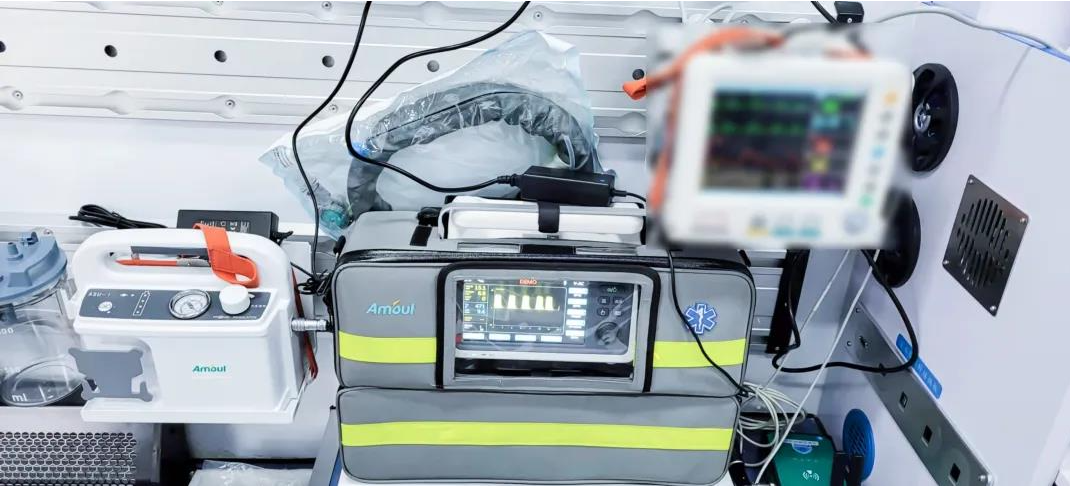
As 5G matures, its mass deployment in the Internet of Things (IoT) is redefining the ambulance from a mere transport vehicle into a fully-connected mobile intensive-care unit. A 5G industrial router must provide continuous, high-reliability networking so that the ambulance’s native functions—vehicle positioning, vital-sign acquisition, real-time streaming, and remote monitoring—can feed the hospital’s smart-medical platform without interruption.
Empowered by 5G, edge computing and artificial intelligence, the “retro-fitted” smart ambulance carries not only standard gear (patient monitor, ECG, defibrillator-pacer, ventilator) but also new perception end-points: vital-sign sensors, audio-visual terminals, AI cameras and intelligent data-loggers. On-board 5G uploads these multi-stream data to the hospital emergency centre with zero-lag and zero-frame-drop.
Scenario
A serious traffic accident occurs. A by-stander dials 120. The regional command centre geolocates the call, dispatches the nearest ambulance and computes the fastest route from live traffic data.
On scene, paramedics triage the driver—critical, unconscious. Through the regional 5G-sharing platform they instantly check bed occupancy, cath-lab availability and queue length of every nearby hospital, then select the facility that can accept the patient immediately.
The moment the patient is loaded, facial-recognition confirms identity; basic vitals, past history and allergy data are pushed to the destination hospital. An in-hospital specialist joins a bidirectional 4K video session, guiding CPR, drug dosage and defibrillation timing while the ambulance is still en-route.
System Functions
Ventilators, multi-parameter monitors, pulse oximeters, NIBP cuffs, defibrillators and IP-cameras are wired to the 5G industrial router via Gigabit Ethernet or RS485/RS232. The router encapsulates the data and forwards it over 5G to the hospital information system (HIS), giving clinicians a live view of the patient’s trajectory and enough lead-time to prepare the catheterisation lab, OR or blood bank.
GPS/Beidou positioning embedded in the router streams ambulance coordinates to the dispatch cloud, optimising fleet utilisation and cutting response time.
In-vehicle surveillance footage is simultaneously uploaded through the same 5G channel, letting senior doctors visually assess the scene and coach junior staff en-route.
System Architecture
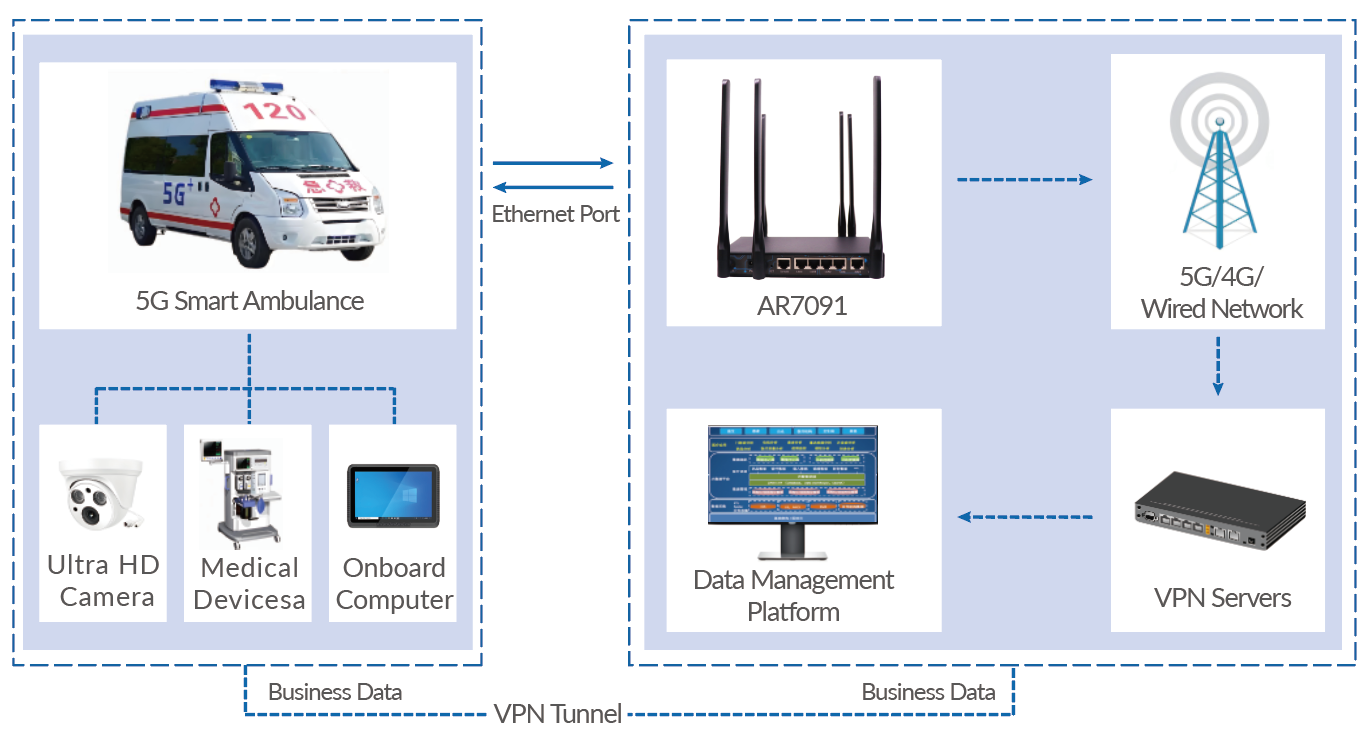
The AR7091 router establishes multiple IPSec/OpenVPN tunnels to hospital-based data-management platforms. Multi-link aggregation (5G + 4G + Wi-Fi) guarantees bandwidth and failover, ensuring data integrity and cyber-security while the vehicle moves across cells.
Operating Principle
1. 5G network: exploits high throughput, ultra-low latency and 99.99 % reliability for bidirectional data exchange with the medical centre.
2. Medical device integration: hosts ECG, NIBP, SpO₂, EtCO₂, ultrasound and imaging devices.
3. Data acquisition & transmission: captures and packetises vital signs in real time.
4. Remote monitoring & diagnosis: specialists view live waveforms and video, issue orders and prepare reception.
5. Location services: continuously reports ambulance latitude/longitude for command-and-control.
6. Video communication: enables HD voice/video calls between cockpit, cabin and hospital.
Product Description
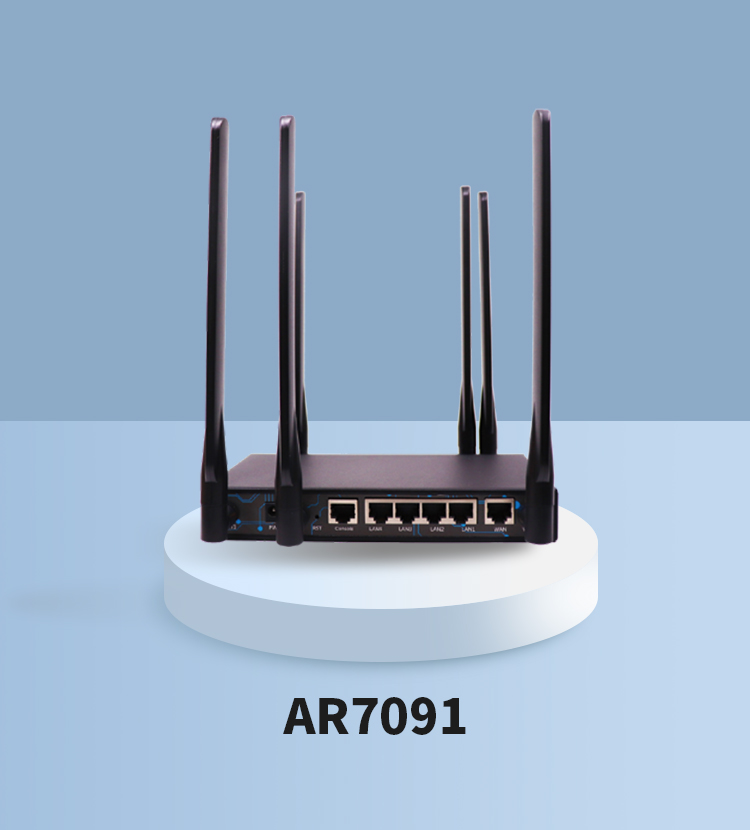
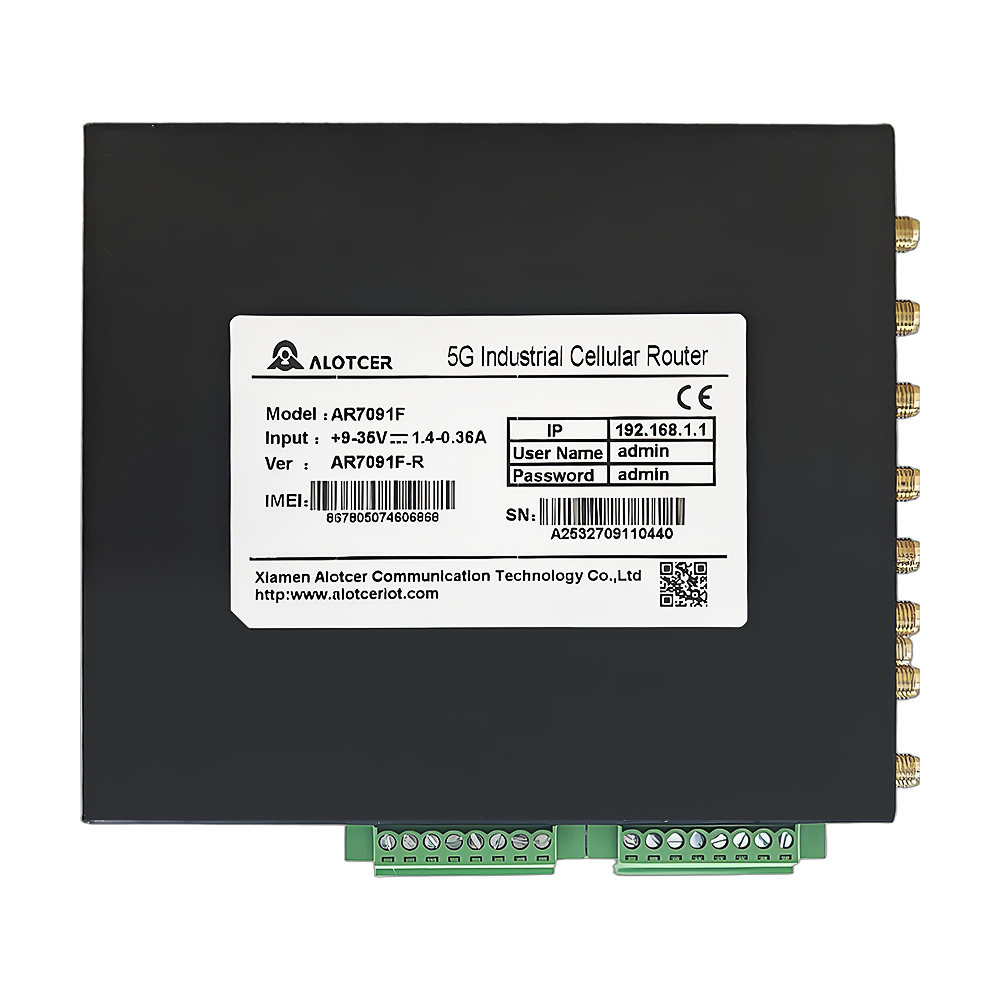
Industrial Gigabit Dual-Band Router / Gateway / CPE – AR7091
Key specifications
– Dual 5G modules, dual-stand-by; 2.4 GHz / 5.8 GHz dual-band Wi-Fi 6
– 5× Gigabit LAN (one configurable as WAN), 1× RS232/RS485 isolated port
– Optional dual-SIM, GPS/Beidou, power-sector encryption, public-private network fusion
– Protocols: MQTT, Modbus TCP, OPC UA, NTRIP, built-in DTU
– VPN suite: IPsec, L2TP, PPTP, OpenVPN, GRE, DMVPN
– Dual-core ARM Cortex-A53, Linux 4.19, Python & C++ SDK for secondary development
– Power: DC 9 – 35 V; idle 3.8 W (4G) / 6.6 W (5G), transmit 4.6 W (4G) / 7 W (5G)
– Operating temp: –35 °C to +75 °C; dimensions 186.8 × 120.2 × 28 mm
System Advantages
1. Full VPN portfolio for end-to-end encryption.
2. Multi-generation cellular fallback (5G/4G/3G/2G) plus dual-band Wi-Fi ensures ubiquitous connectivity.
3. Industrial-grade 32-bit comms processor and cellular module, fan-less design, EMC level 4, ready for –35 °C to +75 °C roadside operation.
4. Concurrent interfaces: 1× Gigabit WAN, 4× Gigabit LAN, 1× RS232/485, dual Wi-Fi, covering legacy serial devices, IP cameras and next-generation IoT sensors in a single box.