In today’s industrial world, secure and reliable connectivity is not just a luxury—it’s a necessity. With the rise of the IIoT, industries are transforming their operations, making them smarter, more efficient, and highly automated. However, this digital leap comes with its own set of challenges. One critical aspect of industrial connectivity is ensuring that PLCs—the workhorses of automation—communicate securely and without interruption. Enter the Industrial VPN Router, the guardian of your PLC network, ensuring that your data stays encrypted, your connections remain reliable, and your system is always ready for whatever comes next.
I. The IIoT: The Need for Secure and Reliable PLC Connections
The IIoT is transforming industrial operations by interconnecting machines, sensors, and systems to drive efficiency, automation, and data-driven decision-making. At the heart of this transformation are PLCs, which are essential for controlling and automating complex industrial processes. However, as more devices and systems become interconnected, ensuring secure and reliable connectivity for PLCs becomes a significant challenge. Cybersecurity vulnerabilities in industrial environments pose real threats, from unauthorized access to data breaches and operational disruptions. As IIoT adoption grows, so does the need for robust security measures to protect PLC networks from these risks. Therefore, businesses must prioritize secure and reliable PLC connectivity to fully harness the benefits of IIoT without compromising safety or efficiency.
II. Introducing Industrial VPN Routers: The Guardians of Your PLC Network
A. Understanding VPN Routers: A Dedicated Device for Secure Network Connections
A VPN router is more than just a standard networking device. It is a dedicated solution designed to provide secure connectivity between different networked systems, especially when these systems are spread across multiple locations. Unlike traditional routers, VPN routers come with built-in encryption capabilities, allowing you to securely transmit data across public and private networks. They form a virtual “tunnel” that protects your data from eavesdroppers, ensuring that sensitive information stays safe.
In an industrial setting, a VPN router is essential for securing PLC communications. It provides an additional layer of security by encrypting data sent between your PLCs and other systems, ensuring that even if data is intercepted, it remains unreadable. Furthermore, industrial VPN routers are designed to withstand harsh environments, offering the reliability and durability needed for industrial applications.
B. The Benefits of VPNs for PLC Connectivity: Enhanced Security, Remote Access, and Scalability
1. Enhanced Security:
At the heart of a VPN is encryption. By encrypting the data exchanged between your PLCs and other devices, a VPN router ensures that your data remains secure from cyber threats. Whether it’s IPsec or OpenVPN, these protocols provide robust security that is critical for protecting industrial control systems from unauthorized access and data breaches.
2. Remote Access:
In modern industrial environments, having remote access to PLCs is a game-changer. Whether it’s for remote monitoring, troubleshooting, or managing operations from afar, a VPN router enables secure remote access, allowing technicians to connect to PLCs from anywhere in the world. This eliminates the need for physical presence, reducing downtime and enhancing operational efficiency.
3. Scalability:
As your operations grow, so does your network. VPN routers are designed with scalability in mind, making it easier to add new devices, integrate additional sites, or expand your PLC network. With the right router in place, you can scale your network without compromising on security or performance.
III. Key Factors to Consider When Choosing an Industrial VPN Router
When selecting an industrial VPN router, several critical factors should guide your decision. First and foremost, performance and throughput are essential to ensure your network can handle the required PLC communication without bottlenecks. High bandwidth capacity guarantees smooth and efficient data transfer, which is crucial for real-time industrial operations. Next, prioritize security features like encryption, authentication protocols, and firewall capabilities to protect against cyber threats. The router must support robust security measures to safeguard sensitive data and prevent unauthorized access. Compatibility is also key—your chosen router should integrate seamlessly with your existing PLC system and network infrastructure to avoid any disruptions. Reliability and redundancy are equally important, as industrial environments often demand high availability. Look for routers with features such as failover and backup connections to ensure continuous operation even during hardware failures or network issues. Finally, consider scalability to accommodate future growth. Your router should be able to expand with your network as your business evolves, allowing you to add more devices or sites without sacrificing performance or security. By balancing these factors, you can select the right industrial VPN router to meet both current and future needs, ensuring a secure, efficient, and scalable network.
IV. Top-Rated Industrial VPN Routers: A Comparative Analysis
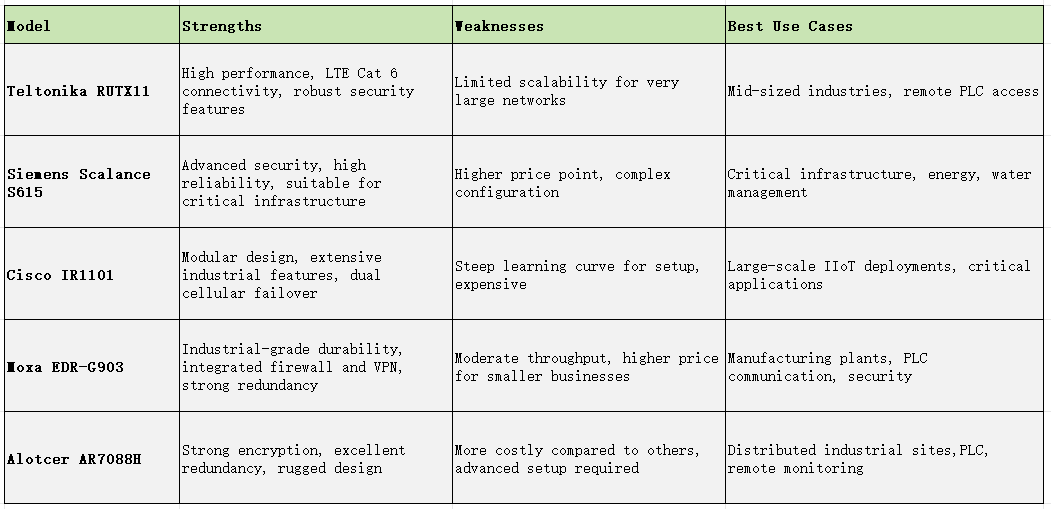
Choosing the best industrial VPN router for PLC connectivity can be daunting due to the wide range of options available. Below is a comparative analysis of some of the top-rated industrial VPN routers, each offering unique strengths, weaknesses, and ideal use cases. This analysis will help you make an informed decision based on your specific operational needs.
Teltonika RUTX11: A Reliable Industrial Router
The Teltonika RUTX11 offers high-speed LTE Cat 6 connectivity, Gigabit Ethernet ports, and dual-SIM failover for reliable network access in industrial environments. Its robust security features protect sensitive data, making it ideal for remote PLC access and IoT device integration.
Siemens Scalance S615: A Secure Router for Critical Infrastructure
The Siemens Scalance S615 is a robust industrial router designed to protect critical infrastructure from cyber threats. Its advanced security features, including firewalls and VPN tunneling, ensure secure data transmission across multiple sites.
Cisco IR1101: A Powerful Router for Industrial IoT
The Cisco IR1101 is a modular industrial router designed to meet the demanding requirements of large-scale IIoT deployments.
Moxa EDR-G903: A Rugged Router for Industrial Networks
The Moxa EDR-G903 is a durable and secure industrial router designed to protect critical network infrastructure.
Alotcer AR7088H: A Secure and Rugged Industrial Router

The Alotcer AR7088H is a durable industrial router designed to provide secure and reliable connectivity in demanding environments. Its key features include:
- Strong encryption: Protect sensitive data from unauthorized access.
- Rugged design: Withstand harsh industrial conditions and extreme temperatures.
- Redundancy: Ensure continuous operation with built-in redundancy features.
Benefits:
- Security: Ideal for applications requiring high levels of data protection.
- Reliability: Operate in challenging environments with minimal downtime.
- Versatility: Suitable for a wide range of industrial applications.
Ideal Applications:
- Distributed industrial sites: Connect and manage remote facilities.
- Remote monitoring and control: Securely access and control equipment from a distance.
- Critical infrastructure: Protect essential systems and services.
V. Advanced Features to Look for in Industrial VPN Routers
When selecting an industrial VPN router, consider these advanced features to optimize network performance and security:
Hardware Acceleration
Boost VPN performance: Improve data transmission speed and reduce latency.
Free up CPU resources: Allow the router to handle other tasks more efficiently.
Ideal for data-intensive applications: Ensure smooth operation for real-time data transfer.
Site-to-Site VPN
Securely connect multiple sites: Enable seamless communication between distributed industrial facilities.
Ideal for global operations: Facilitate data sharing across different locations.
Enhance collaboration and efficiency: Streamline workflows and improve productivity.
Remote Access VPN
Enable secure remote access: Allow authorized users to connect to your network from anywhere.
Facilitate remote troubleshooting and management: Address issues and monitor operations efficiently.
Improve flexibility and responsiveness: Enable remote teams to contribute effectively.
Quality of Service (QoS)
Prioritize PLC traffic: Ensure reliable performance for critical applications.
Prevent network congestion: Avoid delays and disruptions for time-sensitive data.
Optimize resource allocation: Allocate bandwidth effectively to meet the needs of your most important systems.
Failover and Redundancy
Ensure continuous connectivity: Minimize downtime in case of hardware failures or network outages.
Protect critical systems: Maintain operations during disruptions.
Enhance reliability and peace of mind: Have a backup plan in place to mitigate risks.
VI. Deployment Considerations: Installing and Configuring Your Industrial VPN Router
Deploying an industrial VPN router involves several key steps to ensure a secure and reliable connection for your PLC network. Start with the hardware setup by connecting the router to your network infrastructure and PLCs, placing the device in a secure and stable location to protect it from physical damage and tampering. Once connected, proceed to the configuration phase, where you’ll set up VPN tunnels to secure data transmission, define security policies to control access, and configure remote access rules for authorized users. It’s crucial to follow best practices, such as using strong encryption protocols and keeping security settings updated to safeguard against cyber threats. After configuration, integrate the router with your PLC system to ensure seamless communication across all connected devices. Thorough testing at this stage will help identify and resolve any potential issues, ensuring that your VPN is operating efficiently and securely. Proper deployment not only secures your PLC network but also lays the groundwork for future scalability and growth.
VII. Security Best Practices: Protecting Your PLC Network with an Industrial VPN Router
To protect your PLC network, implement the following security measures:
Strong Password Management
- Use complex and unique passwords: Avoid easily guessable combinations.
- Enable multi-factor authentication: Add an extra layer of protection.
- Regularly update passwords: Prevent unauthorized access.
Regular Firmware Updates
- Stay up-to-date: Patch vulnerabilities and improve performance.
- Schedule updates: Set reminders to ensure timely maintenance.
- Follow manufacturer guidelines: Adhere to recommended update practices.
Network Segmentation
- Isolate PLC networks: Limit the impact of potential breaches.
- Reduce attack surface: Minimize the number of vulnerable systems.
- Enhance security posture: Create a more resilient network architecture.
Monitoring and Logging
- Track network activity: Detect suspicious behavior and identify potential threats.
- Use monitoring tools: Monitor network health and performance.
- Analyze logs: Identify security incidents and investigate root causes.
- Implement incident response plans: Have procedures in place to address security breaches effectively.
VIII. Case Studies: Successful Implementations of Industrial VPN Routers for PLC Connectivity
Real-world examples illustrate the importance and effectiveness of using Industrial VPN Routers for PLC connectivity. Here are some case studies that showcase successful implementations across different industries.
A. Manufacturing Plant: Securing Remote PLC Connections for Increased Efficiency
A large manufacturing plant faced challenges with remote PLC connections. By implementing an industrial VPN router, the plant was able to securely connect remote PLCs, allowing technicians to monitor and troubleshoot systems without being on-site. This resulted in reduced downtime, faster response times, and improved overall efficiency.
B. Critical Infrastructure: Ensuring Reliable and Secure PLC Communication for Vital Services
A critical infrastructure provider needed to ensure reliable and secure communication between PLCs across multiple sites. By deploying a network of industrial VPN routers, the provider was able to create a secure, encrypted communication channel that protected against cyber threats while ensuring continuous operation. This implementation proved essential for maintaining the reliability of vital services like energy distribution and water treatment.
C. IoT Deployment: Connecting Industrial IoT Devices to PLCs Over a Secure Network
An IoT deployment project involved connecting a wide range of smart devices to a central PLC network. By using industrial VPN routers, the project team was able to securely integrate these devices, ensuring that data exchanged between IoT sensors and PLCs was encrypted and protected from unauthorized access. This allowed for real-time data collection and analysis, improving operational decision-making and efficiency.
IX. FAQ
A. What are the key differences between VPN routers and traditional routers?
VPN routers are designed to provide secure, encrypted connections between networks, while traditional routers focus primarily on directing traffic within a single network. VPN routers offer advanced security features like encryption protocols and secure remote access, making them ideal for protecting industrial networks and PLCs.
B. Can I use a consumer-grade VPN router for industrial applications?
While it’s possible to use a consumer-grade VPN router in some industrial settings, it’s generally not recommended. Industrial applications require higher security standards, rugged hardware, and features like redundancy and failover that consumer-grade routers often lack. Industrial VPN routers are specifically designed to meet these needs.
C. How do I choose the right VPN protocol (e.g., IPSec, OpenVPN) for my PLC network?
The choice of VPN protocol depends on your specific needs. IPSec is known for its strong security and is widely used in industrial settings. OpenVPN offers flexibility and is easier to configure across various platforms. Consider the security requirements, compatibility with your existing network, and ease of configuration when choosing a protocol.
D. What are the costs associated with implementing an industrial VPN router?
The costs of implementing an industrial VPN router can vary depending on the complexity of your network, the specific router you choose, and any additional features or services you require. Costs may include the price of the hardware, installation, configuration, and ongoing maintenance. However, the investment is often justified by the enhanced security and reliability it provides for your PLC network.
E. How often should I update the firmware on my industrial VPN router?
You should update the firmware on your industrial VPN router regularly, ideally whenever a new update is released by the manufacturer. Staying up to date ensures that your router is protected against the latest security threats and is running as efficiently as possible.
X. Conclusion: AR7088H – The Cornerstone of IIoT Security – Choosing the Right Industrial VPN Router
In today’s IIoT-driven world, securing PLC networks is crucial, and industrial VPN routers are essential in ensuring secure and reliable connectivity. These routers provide advanced encryption, remote access, and robust security features that protect against cyber threats. When selecting an industrial VPN router, key factors to consider include performance, security features, compatibility, reliability, and scalability. The right choice will address current needs while allowing room for future growth. Ultimately, investing in a high-quality industrial VPN router builds a strong foundation for your IIoT network, ensuring your PLCs and critical systems are secure, connected, and equipped to handle future challenges.