I. What Is Power Protocol Conversion?
II. Why Power Industry Heavily Relies on Protocol Conversion (Core Industry Pain Points)
-
Large generation gap between legacy and new equipment leading to incompatible protocols
Traditional station equipment adopts legacy protocols such as IEC101, DL/T645 and Modbus, while new intelligent substations, protection devices, energy storage and photovoltaic equipment adopt the new IEC61850 standard. These two categories of protocols differ completely in message structure, data points and transmission logic, making direct interconnection impossible and resulting in a common dilemma: equipment is online, but data remains inaccessible.
-
Chaotic protocols across multi-brand equipment drive high docking costs
A single power distribution system integrates equipment from dozens of manufacturers, including electricity meters, FTUs, DTUs, protection relays, environmental sensors, inverters and UPS units, each with its exclusive communication protocol. The traditional solution of deploying one converter per device leads to excessive hardware stacking, messy wiring, long debugging cycles and inflated project and operation costs.
-
Inaccurate data mapping causes frequent false and missing alarms
Power systems demand high precision in data, point correspondence and message timing. Generic protocol converters only perform simple transparent transmission, which triggers issues including misaligned data points, incorrect data scaling, lost remote signal status changes and missing protection event uploads. These defects distort master station data analysis, lead to faulty fault diagnosis and remote control failures, and severely threaten the safe and stable operation of power grids.
-
Strict power cybersecurity standards make generic devices non-compliant
The power industry enforces mandatory specifications for communication encryption, message tamper resistance and vertical security isolation. Ordinary industrial gateways only support basic VPN encryption and fail to adapt to power-specific encryption protocols adopted by State Grid, NARI and Inner Mongolia Power. Such devices cannot pass power monitoring system security acceptance tests, leading to project rectification, rework and delivery delays.
III. Core Functions of Mainstream Power Protocols
- IEC101 / IEC104: Core dispatch protocols for communication between substations, power distribution rooms and municipal/county dispatch master stations. They transmit four remote data categories (remote measurement, remote signal, remote control and remote adjustment) and deliver downlink control commands, serving as the foundational standard for distribution automation.
- IEC61850: Universal communication standard for new digital substations, supporting multi-services including GOOSE, SV and MMS. It delivers high transmission speed and comprehensive data dimensions, primarily deployed in newly built intelligent substations and digital distribution renovation projects.
- DL/T645: Exclusive protocol for electricity meters, dedicated to collecting metering data such as voltage, current, power, electricity consumption and line loss, widely used in residential and industrial & commercial metering scenarios.
- Modbus RTU / TCP: Universal industrial protocol extensively adopted by sensors, environmental monitoring equipment, energy storage, photovoltaic inverters and small industrial controllers for data collection.
- Proprietary Encryption Protocols: NARI NRSEC3000, Inner Mongolia Power encryption, State Grid hardware encryption and other standards for high-standard provincial and municipal power projects to guarantee secure and compliant data transmission.
IV. Core Capabilities of Professional Power Protocol Converters
-
Bidirectional multi-protocol interconnection for one-stop protocol translation
Supports bidirectional conversion between mainstream power protocols, including Modbus to IEC104, DL/T645 to IEC104, IEC101 to IEC104, and conversion from all types of private protocols to standard power protocols. It simultaneously accesses multi-brand and multi-type power equipment, unifies data formats and data point models, and completely eliminates data silos across devices.
-
Precise data point mapping to ensure zero distortion of power data
Unlike generic gateways with simple transparent transmission, professional protocol converters support customized point mapping, data scaling, threshold calibration and status change filtering. They accurately match the four-remote data logic of power systems to guarantee precise remote measurement values, real-time remote signal status, complete protection event records and reliable remote control commands, eliminating data misalignment, missing reports and false alarms.
-
Edge-side data preprocessing to reduce master station load
During protocol conversion, edge computing performs data filtering, abnormal value elimination, data aggregation and event sorting. Only valid power data and fault events are uploaded, reducing invalid message flooding and significantly lowering computing power and bandwidth pressure on dispatch master stations, thus improving overall system stability.
-
Power-grade encrypted transmission to meet industry acceptance standards
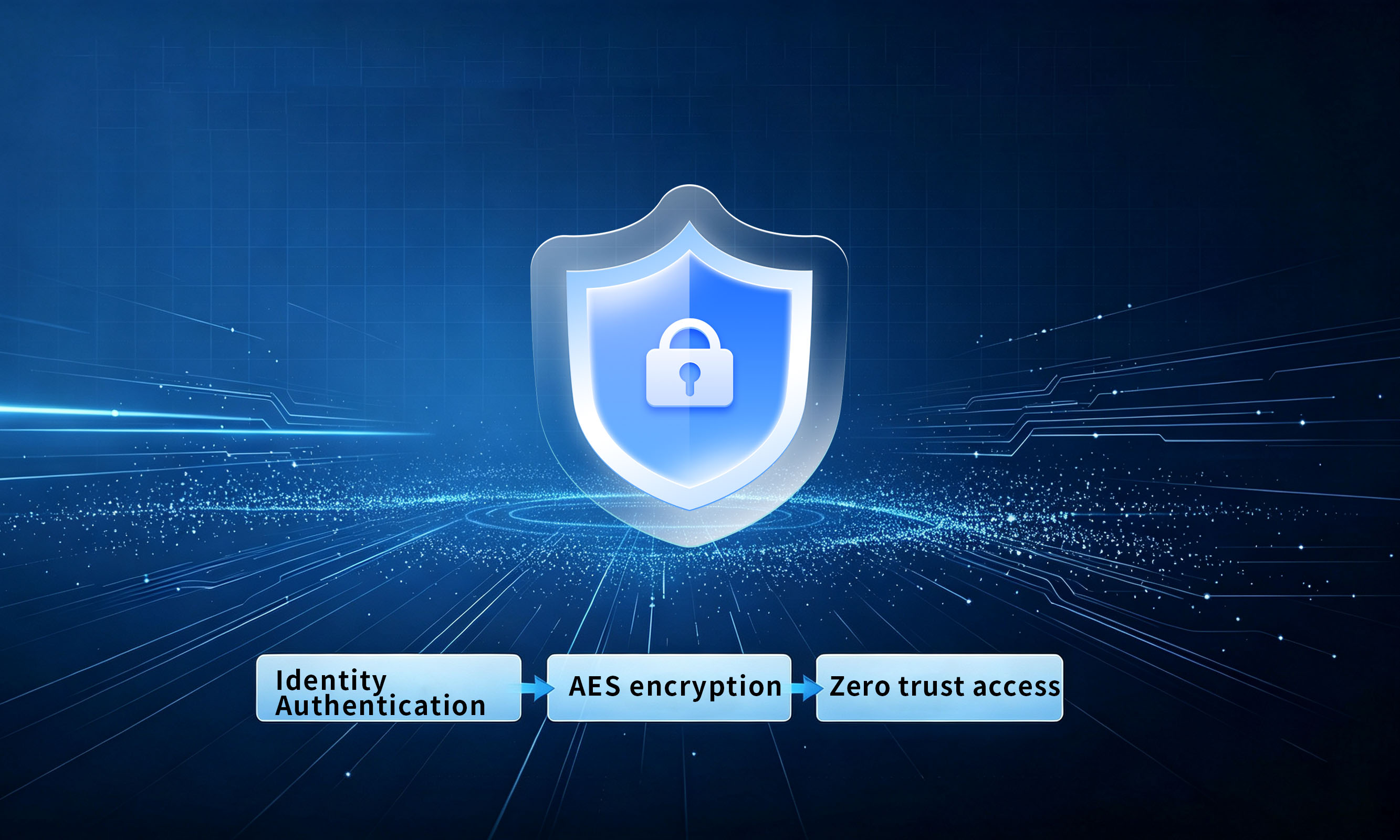
Supports standard VPN encryption plus power-specific hardware encryption, compatible with encryption systems of State Grid, NARI and Inner Mongolia Power. It implements bidirectional message authentication, anti-tampering and anti-eavesdropping functions, complies with power monitoring system security zoning and vertical encrypted transmission requirements, and facilitates smooth project compliance acceptance.
-
Open and customizable to adapt to personalized project demands
Power projects feature diverse scenarios and customized requirements. Professional protocol conversion devices are equipped with open operating systems, supporting secondary development, custom scripting and private protocol parsing adaptation. They can be flexibly adjusted to align with grid standards of different provinces and customized protocol requirements of individual projects, suitable for non-standard and customized power renovation projects.
V. Core Application Scenarios of Power Protocol Conversion
-
Distribution Automation Renovation
In reconstruction of 10kV switching stations, ring main units and low-voltage station areas, the system uniformly connects FTUs, DTUs, smart electricity meters and environmental monitoring equipment, converts multiple protocols into the standard IEC104 protocol for dispatch master stations, enabling full-station online monitoring of four-remote data, automatic fault reporting and remote control operations.
-
Digital Upgrade of Legacy Substations
Resolves compatibility issues between legacy protocols of old substations and the IEC61850 protocol of newly installed intelligent devices, enabling seamless interconnection between old and new systems without full equipment replacement, drastically cutting substation digital renovation costs.
-
Grid Connection of Distributed Photovoltaic & Energy Storage Systems
Photovoltaic and energy storage inverters mostly adopt private Modbus protocols. Protocol conversion unifies these signals into standard grid dispatch protocols, enabling observable and measurable generation data, energy storage status and power load, complying with new energy grid connection specifications and dispatch data upload requirements.
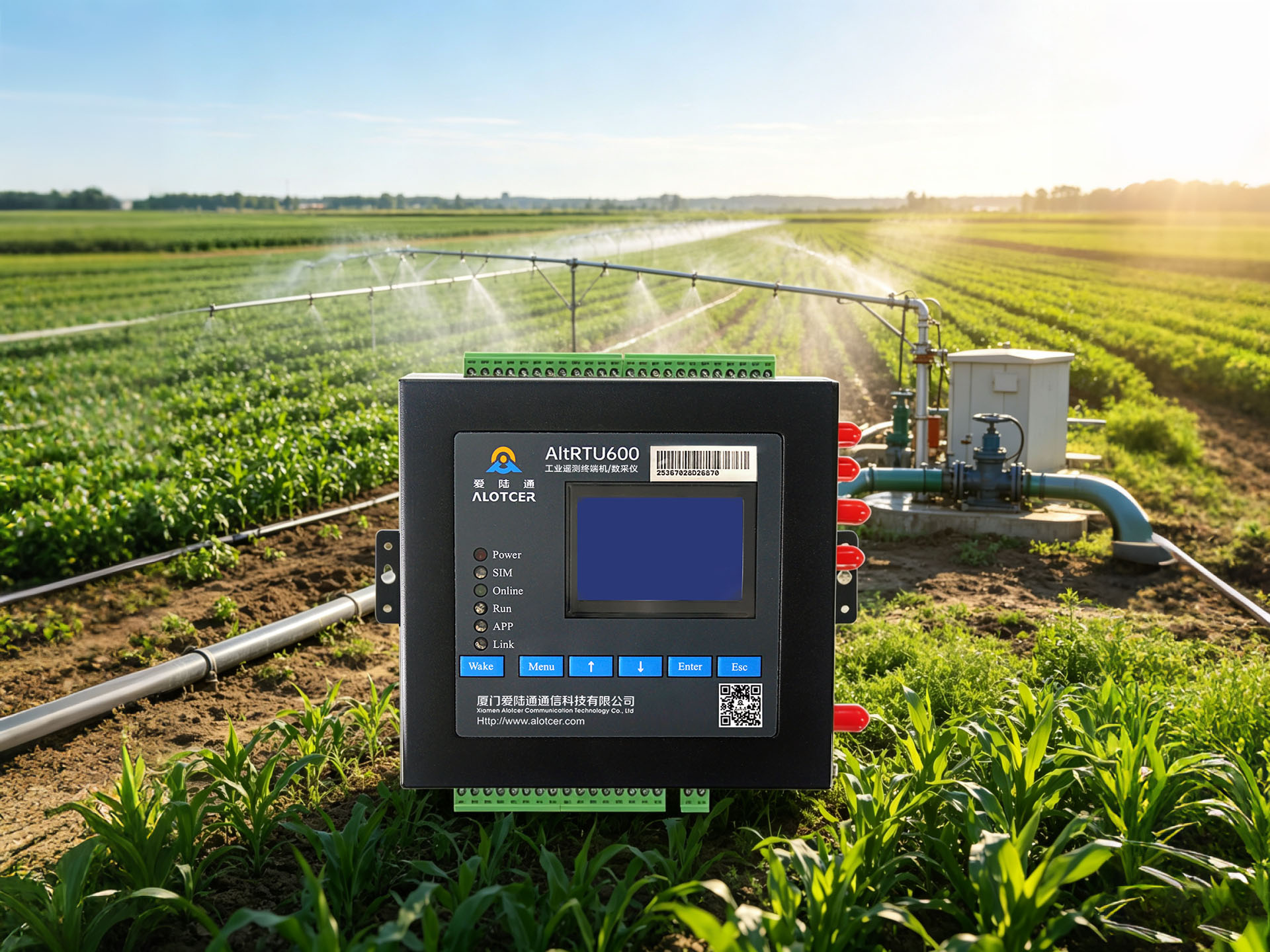
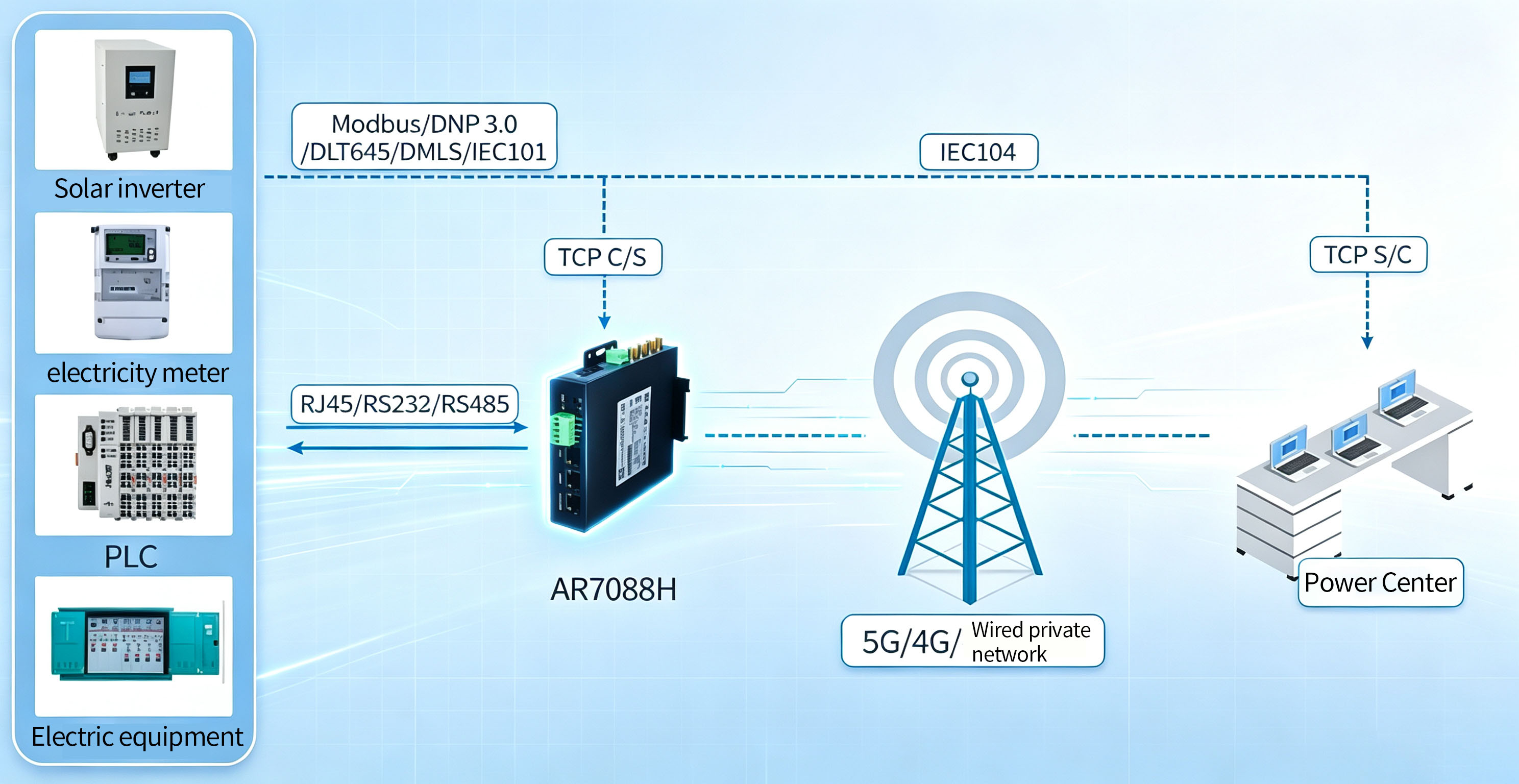
Corresponding architecture: Solar inverters, electricity meters, PLCs and power devices connect to the gateway via RJ45, RS232 or RS485 ports. Downlink protocols including Modbus, DL/T645 and IEC101 are uniformly converted to IEC104, then transmitted back to the power central dispatch platform via 5G/4G or private wired networks.
-
Environmental Monitoring of Power Equipment Rooms
Integrates data from temperature & humidity sensors, water leakage detectors, smoke sensors, access control systems, UPS and air conditioning units, and uploads unified protocol data to power operation & maintenance platforms to realize comprehensive integrated monitoring of power distribution environments.
-
Power Data Upload for Hydropower, Industrial and Mining Self-owned Power Plants
Self-owned power plants of factories and hydropower stations feature fragmented device protocols. Protocol conversion enables standardized data reporting to satisfy digital requirements for power supervision, energy consumption statistics and safety operation & maintenance.