The intelligent meter reading system, as an innovative achievement in the field of electricity management, integrates the functions of automatic electricity information collection, transmission, processing, and real – time monitoring. Once this system is put into use, meter readers no longer need to travel to each user’s location. Instead, they can simply click a mouse in the office to complete meter reading and data entry tasks. Moreover, the system enables real – time remote monitoring, allowing for the prompt detection of electricity usage anomalies, which greatly enhances work efficiency and management levels.
Smart Meters

In modern building construction, it has become a common layout to place numerous electricity meters in a centralized location. These meters are equipped with microcontrollers that can read actual electricity consumption data and interact with external devices through RS – 485 communication. Taking the Alotcer IP MODEM as an example, by leveraging its RS – 485 communication capability and connecting it in parallel with the meters, a basic data transmission channel can be established.
With the widespread application of electronic and microcontroller technologies in the field of electricity meters, intelligent meters have emerged. These are mainly divided into two types: electromechanical meters with microprocessors and fully electronic meters. Electromechanical intelligent meters use the mechanism of the original induction – type electricity meter and read the number of revolutions of the disc through a photoelectric sensor to measure the user’s electricity consumption. Examples include magnetic – card meters, electric – card meters, and IC – card meters. These types of meters have a lower cost and are mostly used for single – phase electricity meters, suitable for residential users. Fully electronic electricity meters, on the other hand, use voltage and current isolation methods, perform A/D conversion, multiply the sampled values, and accumulate them to calculate the user’s electricity consumption. They are mainly used for three – phase electricity billing in enterprise application scenarios. To achieve remote automatic wireless meter reading, it is necessary to select intelligent meters equipped with communication interfaces. Common interface types include RS – 485, RS – 232, CAN – bus transceivers, or infrared.
4G Communication
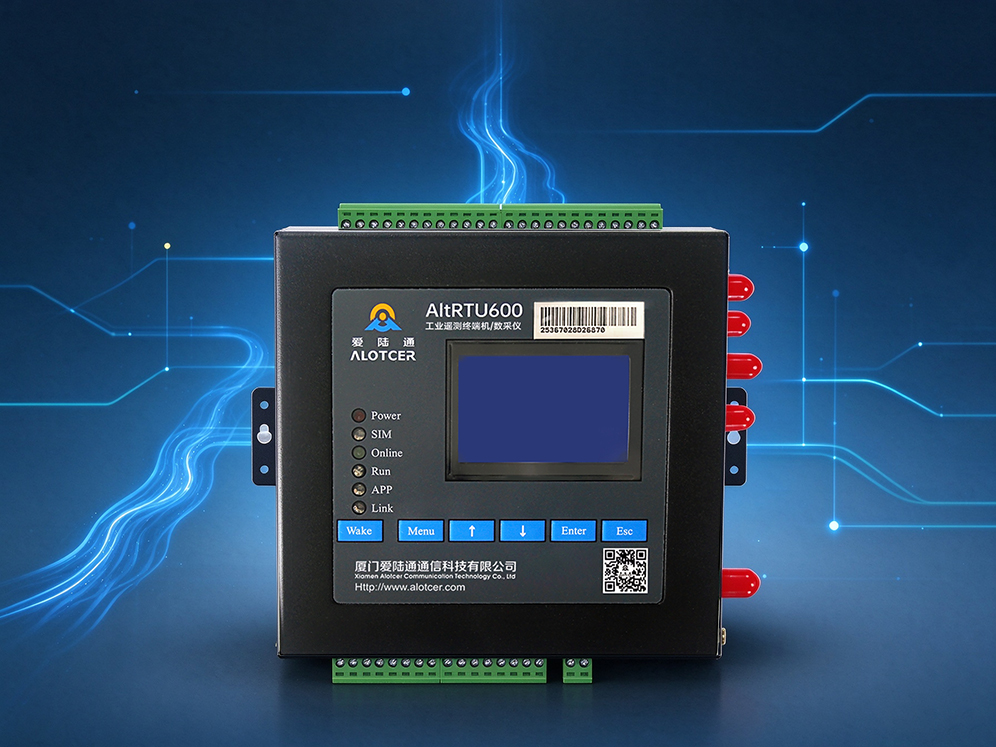
The 4G DTU remote wireless meter – reading terminal, with computer networking and communication technology at its core, uses the 4G wireless network to automatically tally each user’s electricity consumption and transmit it to a remote monitoring center, thereby achieving the goal of automated meter reading. The 4G wireless communication method has significant advantages. It is not restricted by time or location. As long as the area is covered by a mobile network, wireless meter reading can be realized. Alotcer’s 4G DTU wireless meter – reading module can maintain a long – term online status, allowing the management center to obtain accurate electricity meter data through a computer at any time, which provides great convenience for electricity management.
The wireless transmission module (4G DTU) plays a key role in the system, enabling connections to mobile networks and meter – reading data service centers. Through this connection, the meter – reading data service center can directly access each electricity meter, truly realizing the functionality of a remote meter – reading system. In practical applications, the stability and reliability of the 4G DTU are crucial, as they directly affect the accuracy and timeliness of data transmission. Therefore, when selecting a 4G DTU device, it is necessary to comprehensively consider factors such as its performance, compatibility, and after – sales service.
Technical Deployment
The intelligent meter – reading system mainly consists of two parts: the front – end data collection and transmission section, and the central data storage, processing, and display section.
The front – end data collection and transmission section includes devices such as smart meters, wireless DTUs, and equipment protection boxes. The DTU is responsible for collecting meter data and transmitting it to the central server through wireless networks such as GPRS/CDMA/3G. In this process, the performance of the DTU directly affects the accuracy of data collection and the stability of transmission. For example, the DTU needs to have strong anti – interference capabilities to ensure normal operation in complex electromagnetic environments. Meanwhile, the equipment protection box provides necessary protection for the DTU and meters to prevent damage from external environmental factors.
The central data storage, processing, and display section is composed of data servers, application servers, and monitoring screens. Its main responsibilities are to store, analyze, and display the data collected from the front – end. The data server is in charge of storing a large amount of electricity consumption data, providing a basis for subsequent data analysis. The application server processes and analyzes the data to uncover its underlying value. For instance, by analyzing electricity consumption data, user consumption patterns can be understood, providing a basis for power dispatching and energy – saving measures. The monitoring screen visually displays electricity data and system operation status, facilitating real – time monitoring and management by staff.
Core Functions of 4G DTU
The 4G DTU has several core functions in the intelligent meter – reading system. First, it can collect data from each electricity meter under its jurisdiction, such as meter readings and meter status, perform preliminary processing, and then transmit the data to the central station through a data transceiver and communication medium according to the requirements of the central station. This function ensures the accurate collection and timely transmission of electricity consumption data, providing reliable data support for electricity management.
Second, the 4G DTU can store the addresses of the electricity meters under its jurisdiction according to the commands from the central station and set important parameters of the electricity meters, such as meter constants and initial meter readings. This allows the management center to remotely manage and configure the meters, enhancing the flexibility and efficiency of management.
Third, the 4G DTU has networking capabilities, enabling point – to – point or point – to – multipoint signal communication and data transmission between multiple meters. This function allows the system to expand to more meters, meeting the needs of large – scale electricity management. In practical applications, a rational networking approach can improve the efficiency and reliability of data transmission and reduce the costs of system construction and operation.
The application of 4G DTU in the intelligent meter – reading system is of great significance. By properly selecting smart meters, fully utilizing the advantages of 4G communication, scientifically deploying the technology, and leveraging the core functions of the 4G DTU, an efficient, stable, and reliable intelligent meter – reading system can be constructed, bringing a new transformation to electricity management.