As global temperatures climb and summer arrives across the Northern Hemisphere, power rationing and electricity shortages are becoming increasingly common worldwide, disrupting both daily routines and business operations. Against this backdrop, the power clock synchronization system emerges as a critical yet often overlooked backbone of grid infrastructure. Should these synchronization devices fail, the consequences extend far beyond minor inconveniences—they can trigger cascading power anomalies, destabilize grid operations, and ultimately interrupt the reliable delivery of electricity that modern society depends upon. Today, we will explore the fundamentals of power clock synchronization systems, their indispensable role in contemporary smart grids, and why robust timing infrastructure matters more than ever in an era of climate stress and digital transformation.
What Exactly Is a Power Clock Synchronization System?
At its core, a power clock synchronization system is a specialized timing architecture designed to unify time across all nodes of an electrical grid. The process begins with receiving highly accurate reference time—typically from satellite constellations such as GPS, BeiDou, GLONASS, or Galileo, or alternatively from terrestrial sources like atomic clocks or IRIG-B time code generators. This reference signal then undergoes sophisticated processing through standardized time protocols—such as NTP, PTP/IEEE 1588, or power-industry-specific protocols—combined with advanced algorithms that compensate for transmission delays, network jitter, and oscillator drift. The refined time signal is subsequently distributed throughout the power system to substations, control centers, protection relays, phasor measurement units (PMUs), and intelligent electronic devices (IEDs), ensuring that every terminal maintains temporal alignment with the universal reference at resolutions reaching microseconds or even nanoseconds.
Due to this functional identity, the system is interchangeably referred to as a power time synchronization system. Furthermore, because these systems are predominantly deployed at substations—the nerve centers where high-voltage transmission meets local distribution—they are commonly known within the industry as substation clock systems. Their deployment ensures that events recorded across geographically dispersed equipment can be correlated with absolute precision, a capability that forms the foundation of modern grid diagnostics and control.
Why Has Clock Synchronization Become Non-Negotiable for Modern Power Systems?
The imperative for precision timing has intensified dramatically with the evolution of power grids from passive, centralized networks to active, decentralized smart grids. Several converging factors drive this urgency:
First, geographic and topological expansion. Contemporary grids span vast territories, often crossing provincial or national boundaries, and incorporate diverse generation sources—from remote wind farms and solar arrays to distributed energy resources and energy storage systems. Coordinating power flows across such expansive, heterogeneous networks requires that every measurement timestamp be universally meaningful. Without sub-millisecond synchronization, phase angle measurements from different regions cannot be reliably compared, rendering wide-area situational awareness impossible.
Second, the advent of smart grid intelligence. Modern grids rely on pervasive monitoring, automated control, and predictive management. Every intelligent device—from digital protective relays to advanced metering infrastructure—generates event logs, fault records, and operational telemetry. When a disturbance occurs, engineers must reconstruct the sequence of events across dozens or hundreds of devices with absolute certainty. High-precision time synchronization transforms this from a forensic guessing game into a deterministic science, reducing fault location time from hours to minutes or even seconds.
Third, the proliferation of synchronized phasor measurement. PMUs, which sample voltage and current waveforms at rates of 30 to 120 samples per second, depend entirely on GPS-synchronized clocks to compute phase angles relative to a universal timebase. These measurements enable real-time wide-area monitoring, oscillation detection, and stability assessment. A timing error of mere milliseconds can corrupt phasor calculations, leading to false stability assessments or missed instability precursors.
Fourth, network-centric operations and cybersecurity. As power systems embrace IP-based communications, IEC 61850 protocols, and cloud-connected analytics, the network infrastructure itself becomes a timing-dependent system. Network performance monitoring, intrusion detection, and forensic analysis all require precisely synchronized timestamps to trace packet flows, identify anomalies, and correlate security events across geographically separated domains. In unmanned substations or remote renewable generation sites, where human operators are absent, the ability to perform precise remote diagnostics hinges entirely on trustworthy time synchronization.
Fifth, climate-induced operational stress. The very context of rising temperatures and supply constraints that we opened with exacerbates timing requirements. During peak load periods or emergency operations, grids operate closer to stability limits, and the speed of protection system response becomes critical. Synchronized clocks ensure that protective relays operate in the correct sequence, preventing false trips or delayed isolation that could trigger cascading failures during already-stressed conditions.
Recommended Solution: YC8110-4U Synchronization Clock
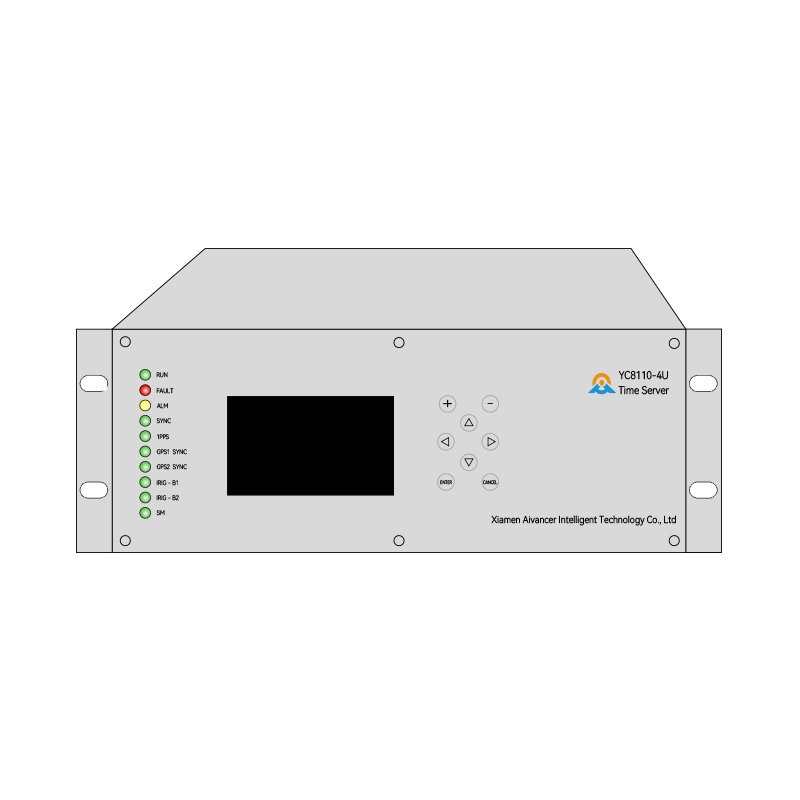
For utilities seeking to fortify their timing infrastructure, the YC8110-4U Synchronization Clock represents a purpose-engineered solution optimized for the rigorous demands of smart power systems. Despite its compact, rack-mountable 4U form factor, it delivers institutional-grade performance through several distinctive capabilities:
Multi-source resilience and intelligent selection. The device receives dual satellite signals alongside external IRIG-B inputs, then applies an optimized multi-source selection algorithm to dynamically choose the most stable and accurate reference. This redundancy ensures continuity even if one satellite constellation experiences degradation or local interference.
Advanced oscillator disciplining and holdover precision. Through sophisticated clock disciplining algorithms, the YC8110-4U continuously trains its internal local oscillator against the selected external reference. Should satellite signals be temporarily lost—during severe weather, antenna obstruction, or intentional jamming—the device transitions seamlessly into holdover mode, maintaining nanosecond-scale accuracy for extended periods based on the learned characteristics of its disciplined oscillator.
Native protocol support for modern substations. The unit fully supports IEC 61850 (including MMS services) and the domestic Chinese CMS protocol, ensuring seamless integration with contemporary substation automation systems. It automatically generates configuration files, dramatically reducing commissioning complexity and ongoing maintenance overhead for field engineers.
Comprehensive monitoring and diagnostic visibility. An integrated time monitoring unit provides real-time visibility into synchronization status across all connected substation devices and systems. It continuously uploads monitoring data, device self-check status, and location information to the master station while archiving abnormal events for post-incident analysis. This visibility transforms timing from an invisible assumption into a managed, verifiable operational parameter.
Robust anomaly suppression. The device incorporates sophisticated filtering and network anomaly suppression capabilities, protecting the timing distribution network against erroneous packets, broadcast storms, or malicious timing attacks that could otherwise propagate through the system.
Leap second and standards compliance. With built-in leap second handling, the YC8110-4U maintains alignment with international atomic time standards, preventing the ambiguity and potential system disruptions that unhandled leap seconds can introduce.
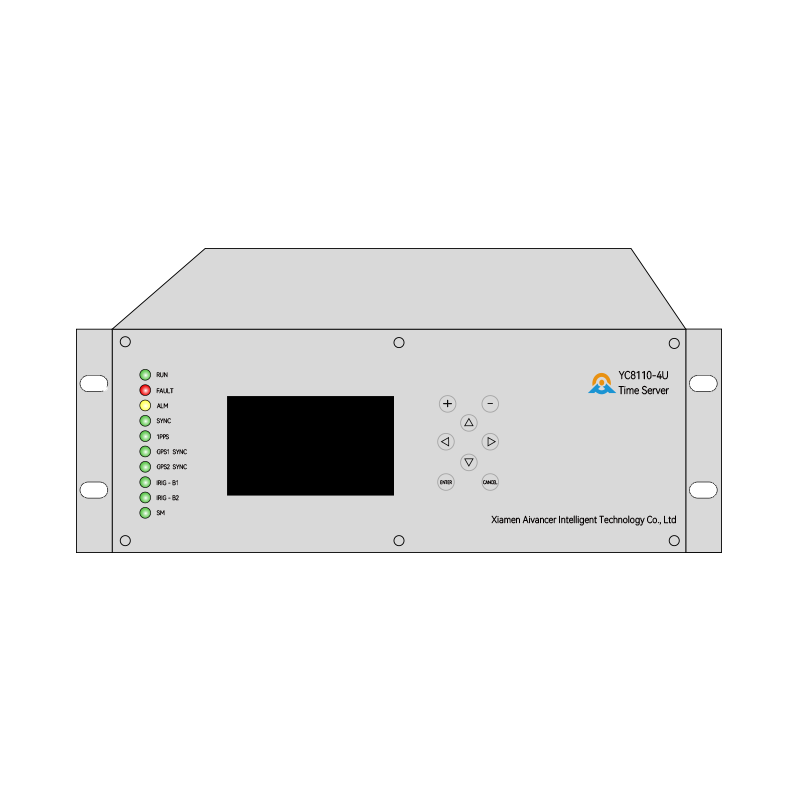
Built entirely on domestic Chinese chips and modules, the YC8110-4U additionally addresses supply chain security and technological sovereignty concerns—a growing priority for critical national infrastructure worldwide.
In an era where electricity reliability faces simultaneous pressures from climate volatility, cyber threats, and the complexity of renewable integration, the power clock synchronization system is no longer merely a supporting utility—it is a foundational layer upon which grid resilience, efficiency, and security depend. Devices like the YC8110-4U exemplify how precision timing infrastructure must evolve to meet these challenges, ensuring that when the lights stay on, it is by design rather than chance.