How much water agricultural irrigation uses has long been a difficult problem. If water meters are installed, sediment in the fields easily clogs them, and they easily freeze and crack in winter, making maintenance costs frighteningly high; if they are not installed, the red line for groundwater overexploitation is there, and the accounts cannot remain unclear forever. Is there a method that avoids struggling with sediment and freeze damage while still calculating water use clearly?
“Electricity-to-water conversion” is aimed precisely at this contradiction. The reasoning is not complicated: pumping water consumes electricity, and there is a relatively stable corresponding relationship between electricity consumption and water output. Once this corresponding relationship is accurately determined, reading the electricity meter number allows one to back-calculate how much water was pumped. The electricity meter is already there, and the power grid’s metering capability is readily available, which is equivalent to bypassing all the troubles of installing water meters in the field.
But the four words “corresponding relationship” are precisely the most uncomplicated part of this matter.
For different machine wells, well depth differs, pump power differs, groundwater depth differs, and even the irrigation rhythm for growing wheat and vegetables differs, so the conversion coefficient cannot be uniform. Liaoning, as one of the country’s first pilot provinces, installed electricity meters, water meters, and sensors on sample wells to actually measure voltage, electricity quantity, water pressure, and instantaneous flow, and calibrated coefficients by comprehensively considering more than twenty influencing factors, then used this coefficient to estimate the water use of other machine wells in the same region. Shaanxi has taken a similar path: first building sample wells with “one meter per well, single use,” accurately measuring the coefficient, and then linking and covering machine wells over a larger area. At present, water-electricity files have been established for nearly 140,000 machine wells. To put it plainly, sample wells are responsible for “calibrating the ruler,” and electricity meters are responsible for “daily measurement.”
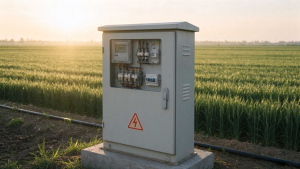
When this logic is applied at the equipment level, the core requirements are actually just two: electricity data must be collected accurately, and data must be transmitted back. The power supply environment of farmland machine wells is often not friendly; voltage fluctuations, signal blind spots, and extreme temperatures are all normal. Telemetry terminals such as the Alotcer AltRTU600S are designed precisely for these on-site conditions. It does not need to install metering components on the water delivery pipeline; instead, it is wired directly in the machine well power supply control cabinet, collects pump electricity-use data, combines it with a pre-entered conversion coefficient to complete water-volume conversion locally, and then uploads it to the regulatory platform via a 4G network. The complexity of on-site deployment is reduced to a very low level, and a single machine well can complete the entire process from wiring to platform visibility in about half a day.
The device’s own industrial-grade protection also determines whether this solution can “survive” in the field. Everyone knows the conditions of field machine well houses: high humidity in summer, low temperatures in winter, and windblown sand in the north. The AltRTU600S has an IP68 protection rating and a relatively wide temperature range adaptability. In implementation projects in Fujian, Shandong, and other places, the failure rate after three consecutive years of operation has been kept at a low level. In terms of data upload, the device is compatible with relevant standards and protocols of the Ministry of Water Resources and can directly connect to provincial water resource regulatory platforms, without requiring the project owner to perform additional system adaptation.
Of course, electricity-to-water conversion is not a one-time deal. Groundwater levels will change, pump efficiency will decline, and conversion coefficients need regular review and correction. But the value of this model lies in the fact that, with extremely low incremental cost, it makes hundreds of thousands of previously “invisible” machine wells measurable and manageable. The electricity meter is already spinning; now what it records is not only the electricity bill, but also a clear water account.