Many people ask this question when they first encounter smart water management: since pressure and flow sensors can already measure data, why add an RTU in between? Why not just connect the sensors directly to the network and transmit to the platform?
This idea sounds reasonable, but in the real scenario of water supply networks, it is almost unworkable.
Sensors “cannot speak”; the RTU is the interpreter
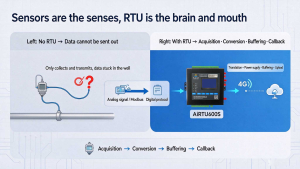
Sensors are responsible for “perception”; they output analog signals or simple serial data. A pressure transmitter gives a 4-20mA current, and a flow meter outputs Modbus register addresses through RS485. Platform servers cannot understand these signals, nor can they store them directly in a database.
The first thing an RTU does is translate the sensors’ “dialect” into “standard language” the platform can understand. It converts analog quantities into digital quantities, parses Modbus registers into meaningful pressure and flow values, and then packages and sends them out via 4G or NB-IoT. Without this step, a sensor is just a lump of iron that only outputs electrical signals.
No power or network down the well; sensors cannot survive on their own
Most monitoring points in water supply networks are down wells, by roadsides, or in the field. Mains electricity cannot be run there, and fiber optics is even less realistic. Although sensors themselves have low power consumption, they have no remote communication capability and no mechanisms such as battery management, sleep wake-up, or offline caching and retransmission.
One of the RTU’s core values is to “keep the whole system alive” in harsh environments. Take terminals deployed down wells such as the Alotcer AltRTU600S as an example: it adopts a low-power architecture and, paired with a large-capacity lithium battery or solar panel, can run continuously for several years, with power consumption controlled at the microampere level during sleep. When the network is interrupted, it caches data locally and automatically retransmits after recovery. Sensors cannot do this; they only know how to measure, not how to “wait until the network is good before sending.”
A site has more than one sensor; the RTU is responsible for gathering them
At actual pipeline monitoring points, pressure transmitters and flow meters are often installed at the same time, and sometimes water level meters and water quality probes as well. If each sensor were equipped with its own communication module and power supply, cost and construction workload would multiply several times.
The RTU’s multi-interface design is meant to solve this problem. The AltRTU600S comes with multiple analog inputs, RS485 serial ports, and pulse collection ports. One terminal can uniformly collect data from several nearby sensors and then upload it through a single communication link. What is saved is not just equipment cost, but also the trouble of down-well wiring, waterproofing, and later maintenance.
So the answer is simple: sensors are the “senses,” and the RTU is the “brain plus mouth.” Installing only sensors without an RTU is like making someone open their eyes but be unable to speak, with the data rotting down in the well.