Background
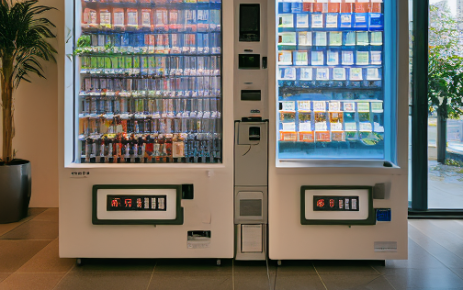
With the development of society and technological progress, self-service vending machines have been widely used in many fields. In modern society, people’s demand for convenient and fast consumption methods is increasing, and self-service vending machines have emerged.
Its development background is closely related to the following factors:
- The acceleration of urbanization process: urban population is dense, consumer demand is diversified, and the demand for convenient shopping is increasing.
- The acceleration of the pace of life: People pursue an efficient lifestyle and hope to quickly obtain the goods they need.
- Technological progress: including the development of electronic payments, the Internet of Things, and other technologies, has provided technical support for the popularization of self-service vending machines.
- Changes in consumer attitudes: Consumer acceptance of self-service is gradually increasing.
- Cost control considerations: For merchants, self-service vending machines can reduce labor and operational costs.
- The advantage of space utilization: It can be placed in various places, such as schools, hospitals, stations, shopping malls, etc., effectively utilizing space.
- 24/7 service: able to provide services 24 hours a day to meet the consumption needs of different time periods.
- Product diversification: There is a wide variety of saleable products to meet the different needs of consumers.
- Intelligent development: With intelligent functions such as inventory management, data analysis, etc.
In short, the application background of self-service vending machines is multifaceted. It adapts to the development needs of modern society, provides consumers with portable shopping methods, and also brings more business opportunities and convenience to businesses
system function
The system functions of self-service vending machines mainly include the following aspects:
- Product sales: Able to sell various products.
- Currency recognition: Accurately identify different currencies.
- Payment processing: Supports multiple payment methods.
- Product management: Classify and manage inventory of products.
- Data statistics: Record sales data for easy analysis.
- Fault detection: Automatically detect equipment faults and alarm.
- Remote monitoring: Implement remote monitoring and management through the network.
- User interaction: Provide a clear operating interface and prompts.
- Advertising display: It can display advertisements and increase revenue.
- Inventory warning: An alert is issued when the inventory of a product falls below the set value.
- Membership system: supports membership functions and provides personalized services.
- Data storage: Secure storage of sales data and related information.
These system functions jointly ensure the normal operation of self-service vending machines, provide users with a convenient shopping experience, and also facilitate management and decision-making by operators.
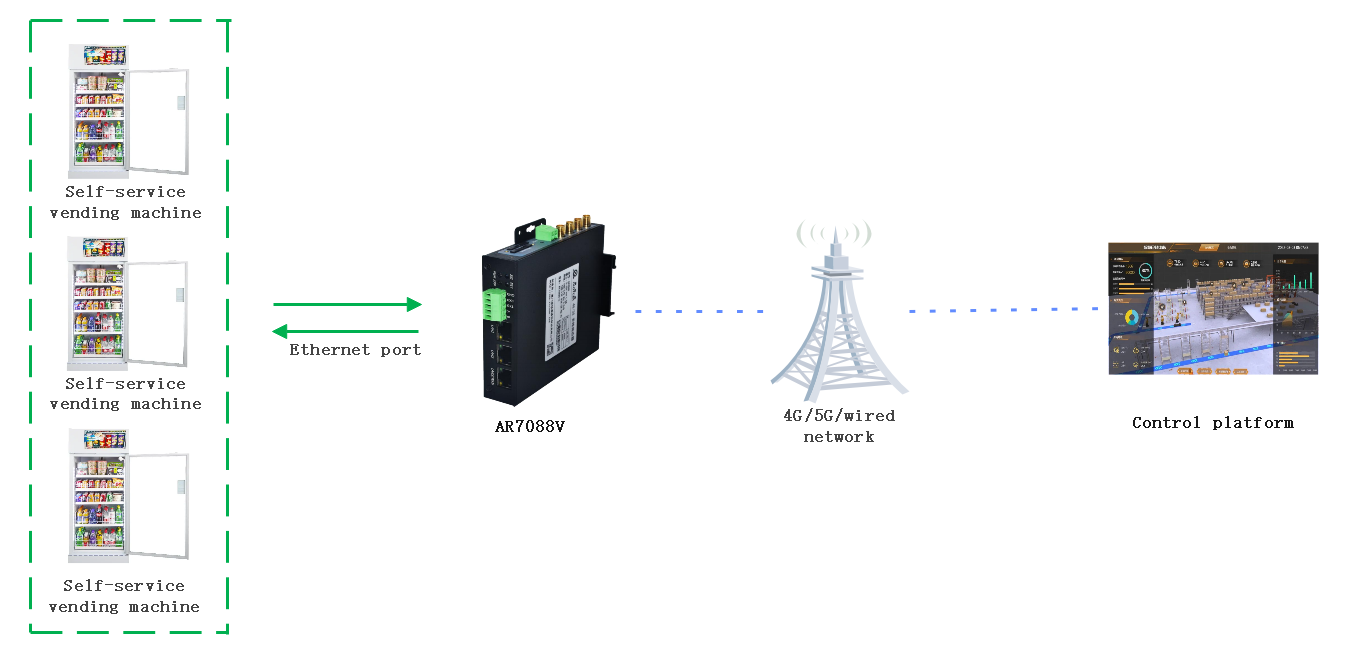
System architecture diagram
Transmission scheme:
Alotcer AR7088V Provide a network for self-service vending machines, and then establish a TCP connection with the control platform to keep the control platform informed of the status of goods inside the vending machines at any time.
Main functions involved: providing network
System Principles
Internal communication: Various components within the self-service vending machine need to communicate with each other, including the product storage management system, user interaction interface, payment system, etc. Usually, serial communication protocols are used, such as RS-232, RS-485, or more modern Ethernet, Wi Fi, etc.
External communication: Self service vending machines need to communicate with external systems, including payment platforms, remote monitoring systems, etc. Modern self-service vending machines typically support multiple communication methods, such as Ethernet, Wi Fi, cellular networks, etc., to connect with cloud services.
Data encryption: In order to ensure the security of communication, self-service vending machines usually use data encryption technology when communicating with external systems, such as SSL/TLS protocol, to ensure the confidentiality and integrity of data during the communication process.
Product Description
Industrial grade router / gateway /CPE-AR7088H
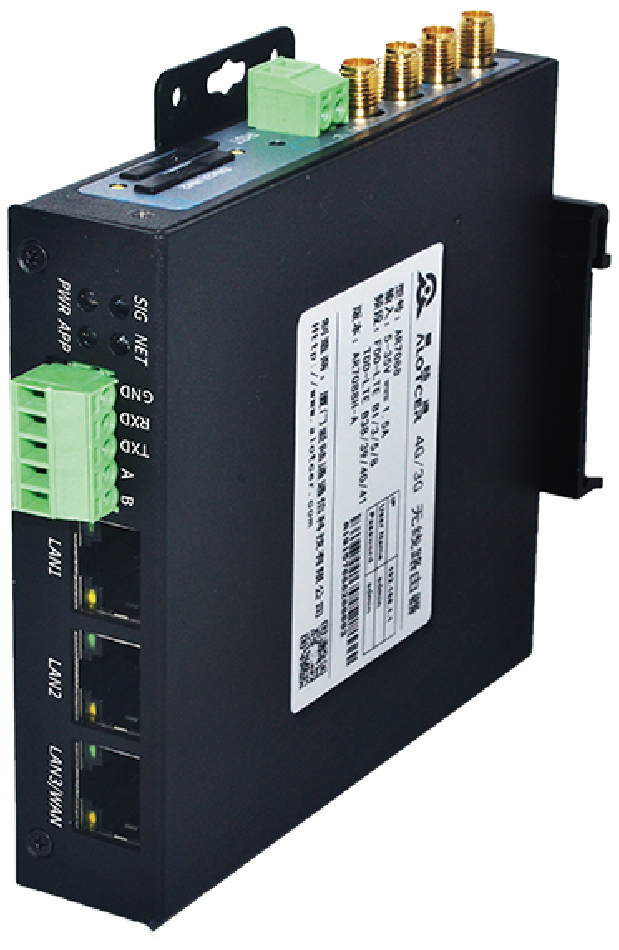
1.5G all network connectivity, SA/NSA dual-mode, compatible with 4G/3G/2G
- 3-way LAN (one can be WAN), 1-way RS232/485
- Optional dual card, GPS, Beidou, power encryption, integrated public and professional, WIFI
4.Support modbus/DNP3.0/DLT645/DMLS/IEC101转IEC104
5.IPSEC、L2TP、PPTP、openVPN、GRE、DMVPN
- Linux system, support for Python, C language secondary development
7.9-35VDC (power version 9-60VDC), online non communication 1.4W, communication 1.9W (12V)
8.Working temperature -35~+75 º C, product size 107x98x24mm
System advantages
- Transparent transmission and support for multiple protocol conversions
- Support secondary development and freely develop the required protocols and conversions
- Support VPN function, which can be applied to various special power networking scenarios