[ez-toc]
Introduction: The Rise of the Cord Cutters and the Quest for Freedom
A. Farewell Cable? Exploring the Growing Trend of Cord Cutting
The era of cable TV and traditional internet is fading as consumers embrace cord cutting, driven by the desire to escape hefty bills and limited options. Cord cutting involves canceling cable TV for internet-based streaming services and alternative broadband solutions. Platforms like Netflix, Hulu, and Amazon Prime, along with high-speed internet, offer freedom from conventional cable setups.
Cord cutters are diverse, from young professionals seeking flexibility to tech-savvy families optimizing media consumption. This shift is driven by on-demand content, cheaper services, and smart devices like TVs and streaming sticks that make accessing content easy. Cord cutting is appealing due to customizable viewing preferences and no long-term contracts.
However, challenges include finding a reliable internet connection for multiple users streaming, gaming, and working from home. This is where 5G Fixed Wireless Access (FWA) and traditional cable internet come into play.
B. The Two Contenders: 5G Fixed Wireless Access (FWA) vs. Traditional Cable Internet
As consumers evaluate their options, 5G Fixed Wireless Access (FWA) and traditional cable internet emerge as primary contenders, each with unique strengths and weaknesses.
5G Fixed Wireless Access (FWA): This technology uses 5G cellular networks to deliver high-speed internet directly to homes via radio signals, eliminating the need for physical cables. It’s attractive for areas without traditional broadband infrastructure, promising high speeds and low latency.
Traditional Cable Internet: This relies on coaxial cables, offering reliable performance and extensive infrastructure in urban and suburban areas. While it may lack the futuristic appeal of 5G, its stability and established presence make it a strong competitor.
In the following sections, we will compare the features, performance, and suitability of each technology for various user scenarios. By the end of this guide, you’ll understand whether 5G FWA or traditional cable internet is the right choice for your home.
Decoding 5G FWA: The New Kid on the Block
A. What is 5G FWA?
5G Fixed Wireless Access (FWA) uses 5G cellular networks to provide high-speed internet to homes via wireless signals, bypassing the need for physical cables. It leverages cellular towers to transmit 5G signals to a specialized receiver (Customer Premises Equipment or CPE) at your home, which then distributes the internet via Wi-Fi or Ethernet.
Advantages:
- Infrastructure: No need for extensive cabling, ideal for rural or hard-to-reach areas.
- Speed: Potentially rivals or surpasses fiber-optic connections.
- Deployment: Quick and straightforward compared to traditional broadband.
Challenges:
- Interference: 5G signals are more susceptible to obstacles like buildings and trees.
- Availability: Currently limited, more prevalent in urban areas.
B. Lightning Speed (or Maybe Not?): Understanding the Potential Speeds of 5G FWA
Theoretical vs. Real-World Speeds:
- Theoretical: Can exceed 1 Gbps.
- Real-World: Actual speeds vary due to factors like network congestion and signal strength.
Factors Influencing Speeds:
- Network Congestion: More users can reduce speeds, especially during peak hours.
- Signal Strength: Affected by distance from the tower, obstructions, and weather.
- Frequency Bands: High-frequency bands offer faster speeds but limited coverage and higher interference; low-frequency bands provide broader coverage but slower speeds.
- Equipment Quality: High-quality CPE and networking equipment enhance performance.
Comparing with Traditional Cable Internet:
- Traditional Speeds: Typically range from 100 Mbps to 1 Gbps.
- 5G FWA: Potential to surpass traditional speeds as technology and infrastructure improve.
Use Case Scenarios:
- Streaming and Gaming: Low latency and high speeds for seamless 4K streaming and lag-free gaming.
- Remote Work: Supports multiple video calls and large file transfers.
- Smart Homes: Handles data needs of multiple connected devices.
In conclusion, 5G FWA offers promising high speeds and low latency but faces challenges like signal interference and limited availability. As technology evolves, it could become an attractive option for many users.
The Reliable Workhorse: A Look at Traditional Cable Internet
A. The Familiar Friend: How Cable Internet Delivers Connectivity Through Coaxial Cables
Traditional cable internet uses a network of coaxial cables, providing reliable internet access. Here’s a concise look at how it works and its advantages.
Infrastructure:
- Coaxial Cable: Consists of a central conductor, insulating layer, metallic shield, and outer insulation, enabling data transmission over long distances with minimal loss.
- Hybrid Fiber-Coaxial (HFC) Network: Combines coaxial cables with fiber-optic cables for high-speed data transmission.
Delivery Process:
- Headend: Central facility processes and sends signals.
- Distribution Network: Signals travel through a combination of cables.
- Neighborhood Nodes: Convert optical signals to electrical.
- Drop Lines: Connect nodes to homes.
- Modem: Converts signals for home use, typically connected to a Wi-Fi router.
Advantages:
- Reliability: Stable connection less affected by weather.
- Widespread Availability: Extensive infrastructure in urban/suburban areas.
- Consistent Speeds: Suitable for streaming, gaming, remote work.
Challenges:
- Shared Bandwidth: Can slow during peak times.
- Equipment Costs: Additional costs for modems/routers.
- Limited Flexibility: Requires physical infrastructure, making expansion difficult.
Use Cases:
- Families: Supports multiple users and devices.
- Businesses: Ensures smooth operations for remote work and online transactions.
B. Stability You Can Count On (Usually): Exploring the Consistency of Cable Internet
Cable internet is known for its stability, crucial for work, entertainment, and communication.
How Stability is Achieved:
- Robust Infrastructure: Coaxial cables minimize signal loss and interference.
- Dedicated Lines: Each home has a dedicated drop line.
- Advanced Technology: Uses DOCSIS to enhance performance and reliability.
Advantages of Stability:
- Seamless Streaming: Minimal buffering and interruptions.
- Online Gaming: Stable, low-latency connection.
- Remote Work: Supports video conferencing and large file transfers.
- Smart Home Integration: Handles constant connectivity demands of IoT devices.
Challenges to Stability:
- Peak Usage Times: Shared bandwidth can lead to slower speeds.
- Physical Damage: Susceptible to damage from construction or natural disasters.
- Provider Quality: Service quality varies between providers.
Use Cases:
- Large Households: Supports multiple online activities.
- Home Offices: Reliable for virtual meetings and cloud services.
- Tech Enthusiasts: Stable connection for smart home devices and high-definition streaming.
In summary, traditional cable internet remains a reliable choice due to its robust infrastructure and consistent performance, despite some challenges during peak times and potential physical damage.
Speed Demons vs. Stability Seekers: Matching Your Needs with the Right Technology
Need for Speed? 5G FWA’s Potential for Blazing-Fast Downloads
For those who crave speed, 5G Fixed Wireless Access (FWA) offers an enticing proposition with gigabit-level speeds and ultra-low latency.
Understanding 5G FWA Speeds:
- High-Frequency Millimeter Waves: Enable vast amounts of data transmission at unprecedented speeds.
- Potential Download Speeds: Up to 1 Gbps, ideal for bandwidth-intensive activities.
Advantages of High-Speed Internet:
- Instantaneous Downloads: Large files, such as movies and games, can be downloaded in seconds.
- Seamless Streaming: Enjoy high-definition content without buffering.
Use Cases:
- Households: Supports streaming, gaming, and remote work.
- Rural Areas: Efforts are underway to expand coverage, promising future improvements.
Cable Internet’s Established Footprint: Availability and Reach of Traditional Cable Networks
Traditional cable internet has long been a reliable option due to its established infrastructure and broad coverage.
Widespread Coverage:
- Urban and Suburban Areas: Extensive network of coaxial cables ensures availability.
- Rural Access: Expanding networks reach more remote locations, though some limitations remain.
Established Providers:
- Major providers like Comcast Xfinity and Charter Spectrum offer a variety of plans, from basic to high-speed.
Advantages of Cable Internet:
- Reliable Connection: Consistent performance less affected by environmental factors.
- Wide Range of Plans: Options for different needs and budgets.
- Bundling Options: Packages that include internet, TV, and phone services for cost savings.
Challenges:
- Shared Bandwidth: Can lead to slower speeds during peak times.
- Physical Infrastructure: Expansion requires significant investment and time.
Use Cases:
- Families: Supports multiple users and devices, ideal for streaming, gaming, and remote learning.
- Small Businesses: Stable connection for video conferencing and online transactions.
- Entertainment Enthusiasts: Consistent performance for high-bandwidth activities.
In summary, traditional cable internet remains a reliable and accessible option with its established infrastructure and widespread coverage. Despite challenges like shared bandwidth, it offers stability and a variety of plans to suit different needs.
The Bottom Line: Making the Right Choice for Your Home Internet
Choosing the right home internet service depends on your needs, location, and budget. Here’s a concise guide to help you decide between 5G Fixed Wireless Access (FWA) and traditional cable internet.
Speed, Stability, and Availability: Weighing the Pros and Cons
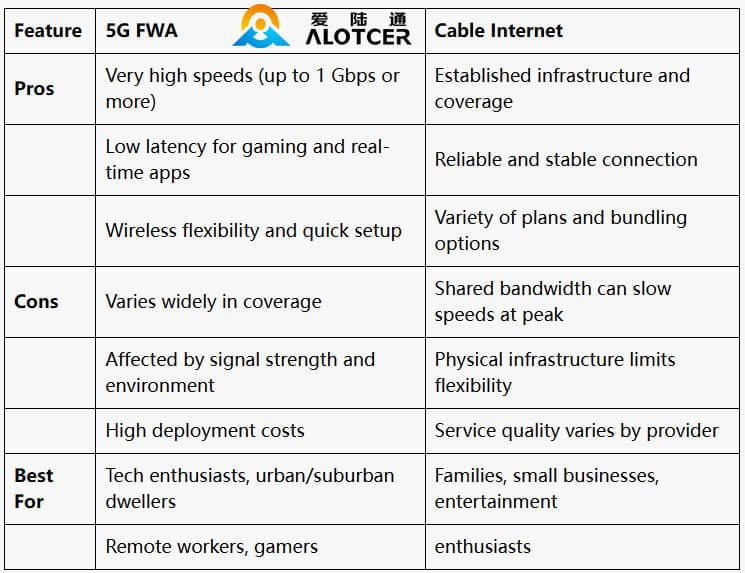
Making an Informed Decision: Tailoring Your Choice to Your Needs
Assess Your Internet Usage:
- Heavy Usage: Activities like 4K streaming, gaming, and large downloads benefit from 5G FWA (if coverage is good).
- Moderate to Light Usage: General browsing and standard-definition streaming are well-supported by cable internet.
Consider Your Location:
- Urban Areas: Both 5G FWA and cable internet are likely available.
- Suburban Areas: Cable internet is usually more available, but 5G FWA is expanding.
- Rural Areas: Cable internet may be more readily available, though 5G FWA coverage is growing.
Evaluate Your Budget:
- Cost Considerations: Compare plan costs, including equipment and installation fees. Bundling services can save money.
- Long-Term Value: Consider potential upgrades and future-proofing options.
Future-Proofing Your Connection:
- Technological Advancements: Stay informed about upgrades like DOCSIS 4.0 for cable and new 5G enhancements.
- Provider Support: Research the customer service quality of local providers.
By evaluating the pros and cons of 5G FWA and traditional cable internet, and tailoring your choice to your needs and location, you can ensure a reliable and satisfying internet experience for your household.
Real-World Scenarios: Choosing Between 5G FWA and Cable
The Mobile Millennial: 5G FWA for Tech-Savvy Users
Meet Sarah:
- Profile: 28-year-old marketing professional, urban resident
- Usage: Remote work, 4K streaming, online gaming, video calls
Why 5G FWA is Ideal:
- High-Speed Internet: Up to 1 Gbps for fast downloads and streaming
- Low Latency: Ideal for gaming and video conferencing
- Wireless Flexibility: No need for extensive wiring, easy to relocate
- Future-Proof Technology: Experience the latest in internet tech
Challenges:
- Coverage and Signal Strength: Ensure strong 5G coverage
- Data Caps: Be aware of potential limits and throttling
Conclusion: For young, tech-savvy users like Sarah, 5G FWA offers the speed, low latency, and flexibility needed for a connected urban lifestyle.
The Streaming Family: Cable Internet for High Bandwidth Needs
Meet the Johnsons:
- Profile: Suburban family of four
- Usage: Multiple smart TVs, gaming consoles, tablets, smart home devices
Why Cable Internet is Ideal:
- Consistent Performance: Stable connection for multiple devices
- Unlimited Data Options: Suitable for heavy internet usage
- Bundling Opportunities: Combine internet, TV, and phone services
- Established Infrastructure: Reliable service with minimal downtime
Challenges:
- Peak Time Slowdowns: Possible slower speeds during high usage times
- Installation and Maintenance: More involved process compared to wireless
Conclusion: For families with high bandwidth needs, cable internet offers reliable performance, ample data, and bundling options, making it a great choice for suburban households.
FAQ
To further assist you in making an informed decision, here are some frequently asked questions about 5G FWA and cable internet:
Is 5G FWA reliable enough to replace cable internet completely?
- Answer: 5G FWA can be highly reliable, especially in areas with strong 5G coverage. However, its reliability can be affected by factors such as signal strength, weather conditions, and network congestion. In urban and suburban areas with robust 5G infrastructure, 5G FWA can be a viable replacement for cable internet. It’s important to check coverage maps and consider a trial period to test the service’s reliability in your specific location.
What happens if I reach my data cap with 5G FWA?
- Answer: If you reach your data cap with 5G FWA, you may experience reduced speeds or additional charges, depending on your provider’s policies. Some providers may throttle your speeds during peak times or after reaching a certain data threshold. It’s crucial to review your plan’s terms and choose a plan with sufficient data to meet your needs, or consider a provider that offers unlimited data options.
Can I use my existing cable TV package with 5G FWA?
- Answer: Typically, 5G FWA and cable TV packages are offered by different providers, so you may not be able to bundle them together. However, some 5G FWA providers offer streaming TV services that can serve as an alternative to traditional cable TV. You can also use streaming services like Netflix, Hulu, and Amazon Prime Video over your 5G FWA connection to replace your cable TV package.
How can I check if 5G FWA is available in my area?
- Answer: To check if 5G FWA is available in your area, visit the websites of major 5G FWA providers and use their coverage maps or availability check tools. You can also contact the providers directly for more detailed information. Keep in mind that coverage is rapidly expanding, so even if 5G FWA is not currently available in your area, it may become available soon.
What are the best internet speeds for streaming services, gaming, and video conferencing?
- Answer: The optimal internet speeds for various activities are as follows:
- Streaming Services: For HD streaming, you need at least 5 Mbps per stream. For 4K streaming, you need at least 25 Mbps per stream.
- Gaming: Online gaming requires a minimum of 3 Mbps for downloads and 1 Mbps for uploads, but higher speeds (25 Mbps or more) are recommended for a smoother experience.
- Video Conferencing: For standard video calls, you need at least 1 Mbps for both downloads and uploads. For HD video conferencing, 3 Mbps for downloads and uploads is recommended.
Conclusion: Cutting the Cord with Confidence – Choosing the Best Home Internet Option for You
A. Recap: Weighing the Pros and Cons of 5G FWA and Cable Internet
5G FWA:
- Pros: High potential speeds, low latency, wireless flexibility, future-proof technology.
- Cons: Variable coverage, signal strength issues, data caps, higher deployment costs.
Cable Internet:
- Pros: Reliable and consistent performance, wide coverage, bundling options, unlimited data plans.
- Cons: Shared bandwidth can lead to slowdowns, more involved installation, service variability.
B. The Importance of Understanding Your Needs: Matching Your Internet Habits with the Right Service
When choosing between 5G FWA and cable internet, it’s essential to consider your specific needs and usage patterns. Identify what matters most to you—whether it’s speed, reliability, coverage, or cost—and select the service that aligns best with your lifestyle.
C. The Future of Home Connectivity: Staying Informed as Technology Continues to Evolve
The landscape of home internet connectivity is constantly evolving, with new technologies and advancements on the horizon. Staying informed about the latest developments can help you make better decisions and future-proof your internet setup. Both 5G FWA and cable internet are set to see improvements in speed, reliability, and coverage, ensuring that you can enjoy a connected home for years to come.