Alotcer has long been dedicated to the field of IoT communication and industrial automation, with a sustained focus on data transmission efficiency in pipe network monitoring scenarios. In traditional pipe network monitoring modes, pipe network RTUs mostly adopt a scheduled reporting strategy — collecting and uploading data at fixed intervals (e.g., every 5 minutes or 30 minutes). This “step-by-step” approach may seem reliable, but it has two significant drawbacks: first, a large amount of redundant data consumes communication resources and battery power; second, truly critical abnormal events may be perceived with delay because the reporting cycle has not yet arrived. How to optimize data collection strategies and evolve pipe network RTUs from “scheduled reporting” to “event-triggered” has become a key challenge in reducing operational costs and improving monitoring responsiveness.
The “Efficiency Trap” of Scheduled Reporting
The working logic of scheduled reporting is simple: the RTU collects sensor data according to a preset cycle and uploads it on schedule, regardless of whether the data has changed or not. The problems with this model are obvious.
First, waste of power and data traffic. Many monitoring points in pipe networks are deployed in unelectrified environments such as manholes and pumping stations, relying on battery power. If data is collected every 5 minutes and reported every 30 minutes, the RTU is frequently awakened, significantly shortening battery life. Moreover, for data that remains stable within normal ranges over long periods (such as pipeline pressure and water level), repeatedly uploading identical values wastes both communication traffic and device power.
Second, delayed anomaly response. When pipeline pressure drops sharply or water level exceeds limits, if this occurs between two reporting cycles, the monitoring center cannot learn about the abnormality until the next scheduled report. For scenarios requiring second-level responses—such as gas leaks or pipe bursts—such delays can lead to serious consequences.
Event-Triggered: Let Data “Speak” Proactively
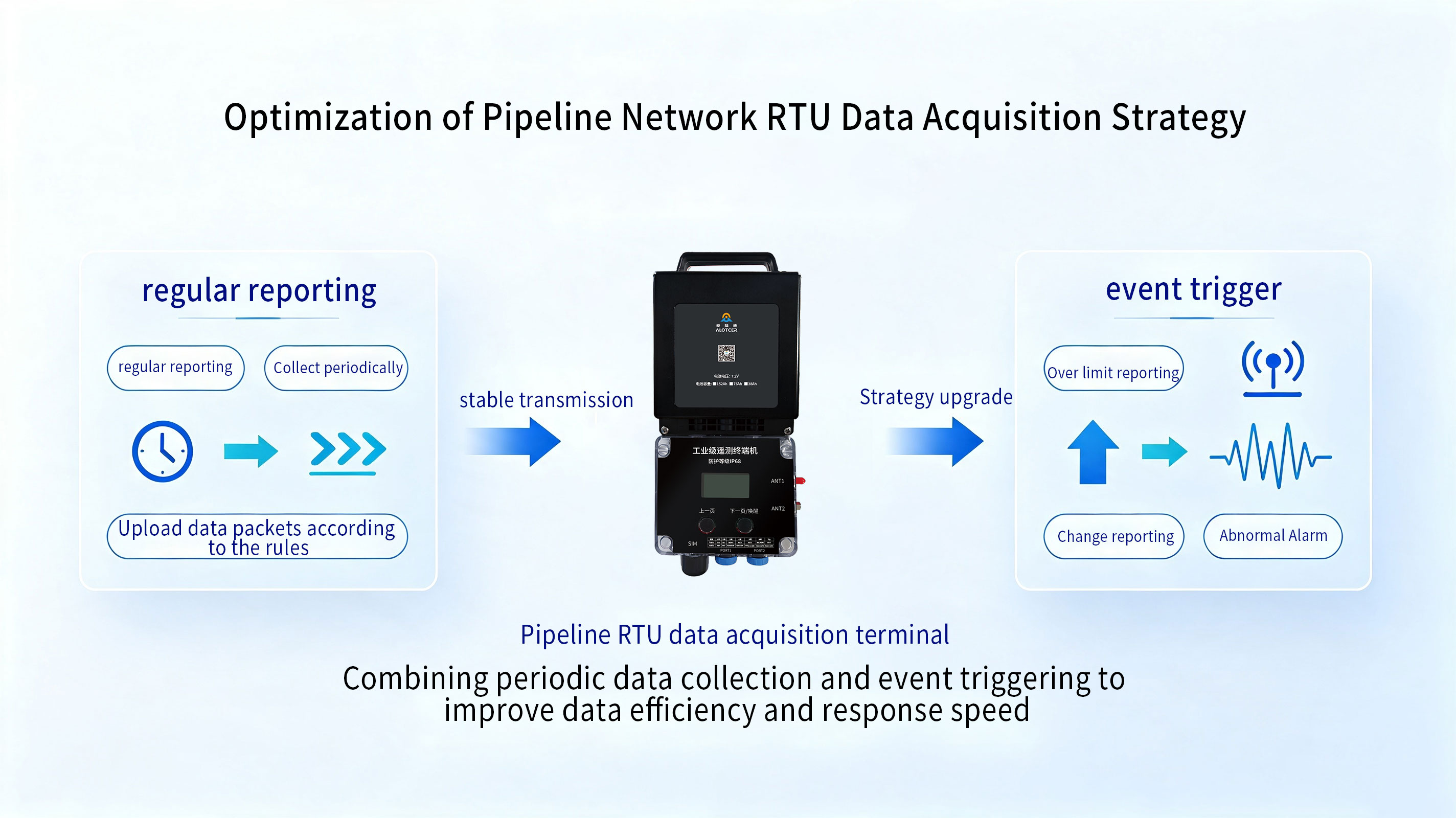
The core idea of the “event-triggered” strategy is: low-frequency reporting under normal conditions, immediate alarm under abnormal conditions. Instead of mechanically uploading data at fixed cycles, the pipe network RTU autonomously decides when to “speak” based on data changes.
Specifically, Alotcer pipe network RTUs support the following event-triggered mechanisms:
Threshold-Exceedance Supplemental Reporting: The RTU simultaneously determines whether the collected data exceeds preset thresholds. Once pressure, water level, or flow exceeds the upper or lower limit, it triggers an immediate report without waiting for the scheduled reporting cycle. This ensures that abnormal events are promptly notified to the monitoring center at the earliest possible moment.
Change-Based Reporting: When data changes significantly compared to the last reported value, the RTU proactively uploads the latest data. For example, when pipeline pressure fluctuates beyond a set percentage, a report is triggered, allowing the monitoring center to track dynamic changes in a timely manner.
Flexible Reporting Cycle Configuration: Users can independently set data collection cycles and reporting cycles based on the importance of monitoring points and site conditions. For instance, data can be collected locally every 5 minutes but reported centrally every 2 hours, ensuring no data loss while significantly reducing communication frequency and power consumption.
Alotcer’s Optimization Practices for Pipe Network RTU Collection Strategies
The Alotcer AltRTU600 series incorporates comprehensive optimizations in data collection strategies. The product supports multiple operating modes, including self-reporting, polling, and hybrid modes, allowing users to flexibly configure collection cycles, reporting cycles, and alarm thresholds based on actual requirements.
In terms of low-power design, the AltRTU600 supports controlled power supply to sensors — powering them only during the brief collection moment and cutting off power the rest of the time. Combined with event-triggered reporting strategies, battery life in battery-powered scenarios can be significantly extended.
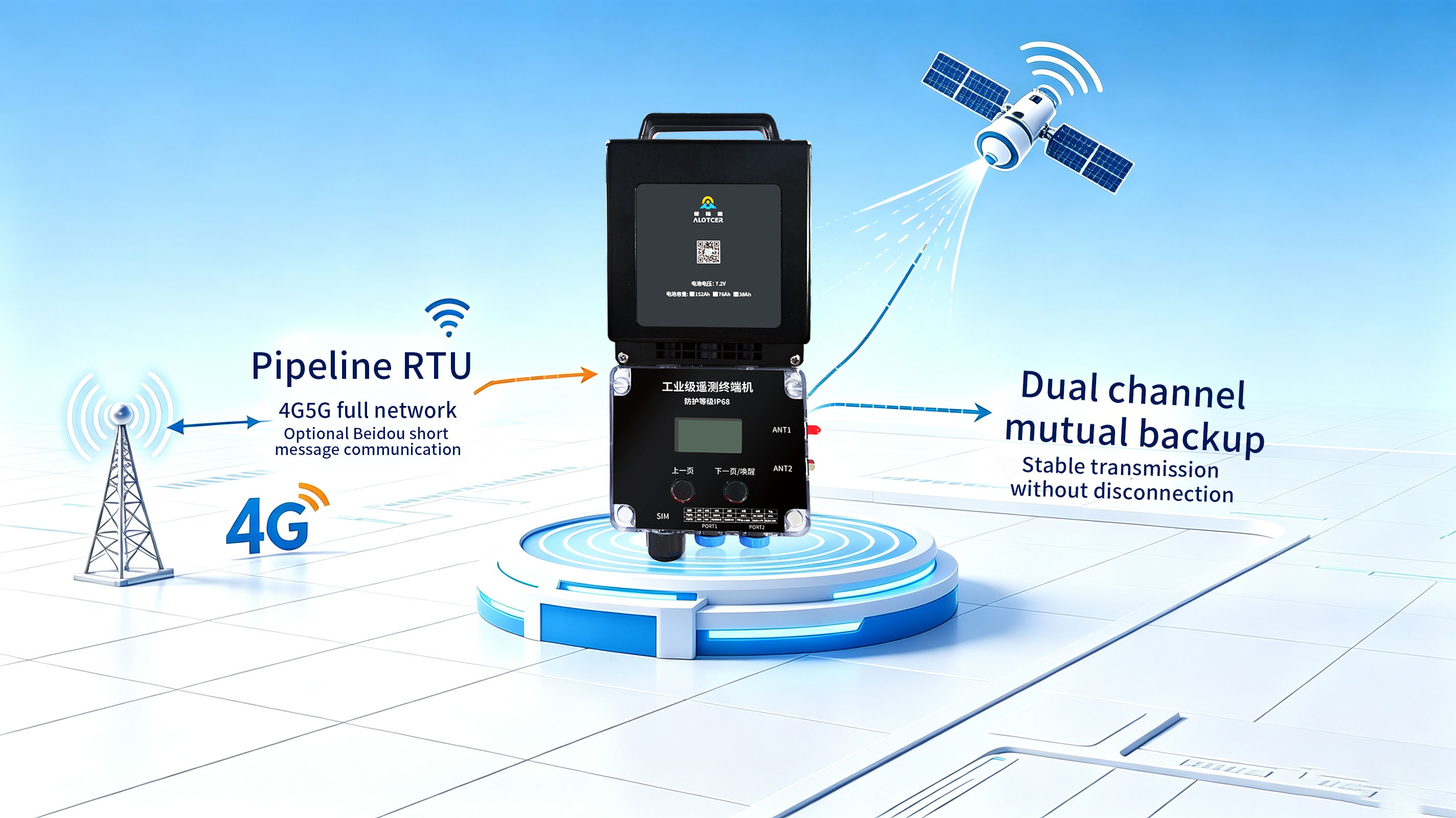
For communication capabilities, the product supports 5G/4G full-netcom and optionally features BeiDou short-message communication, ensuring that once an event is triggered, data can be delivered to the monitoring center via the fastest and most reliable path.
Summary
The evolution from “scheduled reporting” to “event-triggered” is not merely a change in operating mode — it represents an upgrade in the philosophy of pipe network monitoring: letting data “speak” proactively rather than passively waiting to be read. Through strategies such as threshold-exceedance supplemental reporting, change-based reporting, and flexible cycle configuration, Alotcer pipe network RTUs significantly reduce device power consumption and communication costs while ensuring monitoring effectiveness, making pipe network monitoring smarter and more efficient.
FAQ
Q1: Under the event-triggered mode, will any data be missed?
No. The pipe network RTU’s local storage mechanism completely records every data collection. Even if no report is triggered, the data is saved in the device and can be accessed for historical queries and supplementary reporting.
Q2: Can threshold-exceedance reporting thresholds be customized?
Yes. Alotcer pipe network RTUs allow users to set upper and lower alarm thresholds for different monitoring parameters—such as pressure, water level, and flow—independently via the remote configuration platform or local debugging tools, flexibly adapting to different scenario requirements.
Q3: Can the event-triggered mode and scheduled reporting mode be used simultaneously?
Yes. Alotcer pipe network RTUs support a hybrid mode — the device reports routine data at scheduled intervals while simultaneously monitoring for threshold exceedances in real time. Both operate in parallel, ensuring both data continuity and instant response to anomalies.
Q4: How much power can the event-triggered mode save?
Power savings depend on the reporting cycle settings and the frequency of data changes. In scenarios where pipeline pressure and water levels are relatively stable, a combined strategy of event-triggered plus low-frequency scheduled reporting can reduce reporting frequency by 50%–80%, significantly extending the service life of battery-powered devices.
Q5: What types of trigger conditions does the Alotcer pipe network RTU support?
It supports multiple trigger condition configurations, including value threshold exceedance (upper/lower limit alarms), value change rate exceedance, digital input state changes (such as switch triggers), and combined logic triggers, meeting personalized requirements for complex scenarios.