For decades the image of a municipal “water man” with clipboard and rubber boots—knocking on basement doors to read dusty dials—was as familiar as the postman. Yet this quaint ritual is quietly disappearing. Cities now demand litre-level accounting, leak alerts in minutes, and demand curves that update faster than a Twitter feed. LoRa-enabled smart water meters, stitched together by industrial-grade gateways, have stepped into the gap. Below is a field-level look at why utilitiesthe world over are swapping screwdrivers for spectrum analysers, and how to deploy the technology without drowning in hype.
I. The old way: clipboard chaos

Manual meter reading is a master class in inefficiency. Labour accounts for 5–7 % of a utility’s OPEX, error rates hover at 2–4 %, and “estimated billing” erodes customer trust. More importantly, data arrives 4–6 weeks late—long enough for a silent leak to turn a mansion into a swimming pool. During peak-demand hours engineers fly blind, balancing supply with little more than weather forecasts and prayer.
II. LoRa to the rescue: precision in real time
LoRa (Long Range) chirp spread-spectrum works like a whisper that travels kilometres. Sub-GHz bands (470 MHz in China, 868 MHz in EU, 915 MHz in US) penetrate three concrete floors or 30 cm of cast iron—perfect for meter pits.
1. Metrology that talks
Modern LoRa meters capture not only cumulative consumption but also:
– Instantaneous flow rate (0.5 L resolution)
– Reverse-flow events (tamper or faulty plumbing)
– Magnetic interference (attempted fraud)
– Battery voltage & valve status
All data are time-stamped and stored in 15-minute buckets, giving engineers a demand curve sharp enough to calibrate hydraulic models.
2. Peak-hour heroics
During morning rush a neighbourhood of 5 000 flats can see demand surge 250 %. The utility’s SCADA sees the LoRa gateway upload aggregated readings every 5 minutes; if flow exceeds 120 % of nominal, an algorithm boosts pump speed or opens a pressure-regulating valve automatically. Result: no more third-floor showers that dribble like a coffee percolator.
III. Gateway: the unsung brain
A single LoRa gateway, roughly the size of a paperback, can hear 2 000 meters across 3 km line-of-sight while sipping <5 W. Mount it on a water-tower and you own the airspace.
1. Anatomy of a smart-meter subnet
– Meter: counts pulses, detects anomalies, transmits at +20 dBm every 15 min
– Repeater (optional): tiny LoRa module in meter pits too deep for RF
– Gateway: multi-channel SX130x chip, IP67 housing, 24 V DC input
– Back-haul: 4G LTE or Ethernet to billing server
2. Zero-touch commissioning
Meters ship with QR-coded DevEUI. A field tech scans the code through a mobile app; the join-request is automatically routed to the gateway, which forwards it over MQTT-TLS to the network server. OTAA keys are exchanged, and the meter is online in <30 s—no laptop, no command line.
3. Security baked in, not bolted on
AES-128 end-to-end encryption plus frequency-hopping defeats replay attacks. Each meter owns a unique AppKey burned at the factory; even if one node is compromised, the rest of the mesh remains watertight.
IV. Choreography of wireless reading
The dance between meter, gateway and billing software is a study in elegant simplicity.
1. Downlink path
Billing server → 4G LTE → Gateway → LoRa → Meter
Example: “Close valve for non-payment” or “Switch to hourly reporting during drought.”
2. Uplink path
Meter → LoRa → Gateway → 4G LTE → Billing server
Payload is 11 bytes: cumulative volume (4 B), alarm bitmap (2 B), battery (1 B), CRC (4 B). At 0.3 kbit/s SF9, one packet transmits in 62 ms—short enough to meet duty-cycle regulations worldwide.
3. Conflict avoidance
LoRaWAN Class A protocol schedules two receive windows after each uplink, eliminating collisions. With ADR (adaptive data rate) the network server throttles SF12 meters to SF8 once signal strength allows, doubling network capacity without extra gateways.
V. Hardened for the concrete jungle
Smart meters must survive basements that freeze in winter and steam in summer.
1. Dual-wireless redundancy
3G/4G LTE provides primary back-haul; LoRa acts as a local mesh. If the cellular tower is down, critical alarms (leak, tamper) are still logged and forwarded once LTE returns.
2. Industrial-grade 4G module
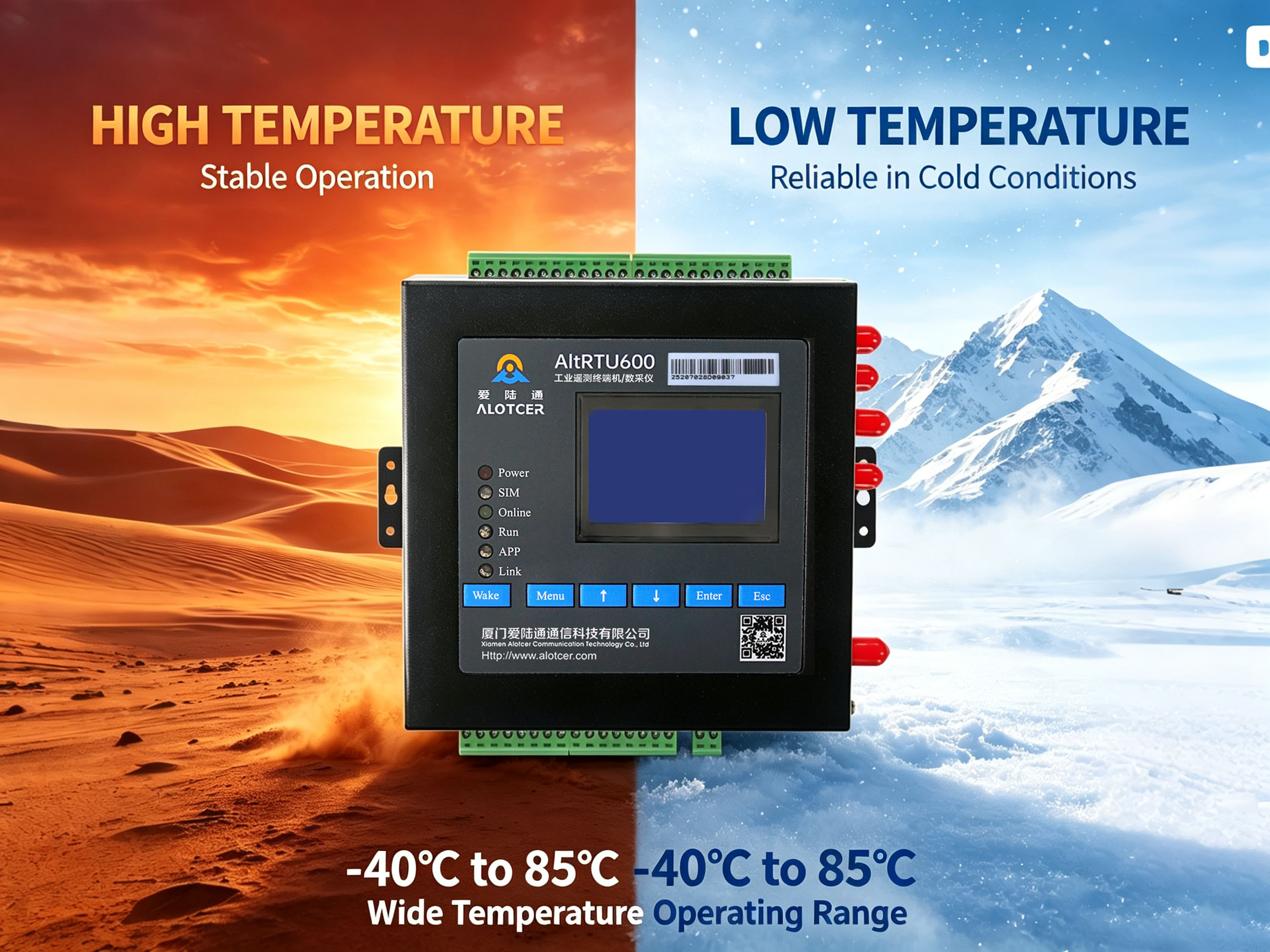
-40 °C to +85 °C operational, 5 %–95 % RH non-condensing, 2 kV surge on antenna port. MTBF > 200 000 h per Telcordia SR-332.
3. Wi-Fi overlay for technicians
A built-in 2.4 GHz radio creates a local SSID for walk-by diagnostics with a smartphone—no need to open the pit lid on a rainy night.
4. APN/VPDN private tunnel
Meters live on a white-listed APN with static private IPs; traffic never touches the public Internet, slashing the attack surface for ransomware.
VI. Bandwidth on a diet—and a diet you can control
LoRaWAN is stingy by design: 0.3–5 kbit/s. Yet for meter reading, that is plenty. A utility can define QoS profiles:
– Priority 1: leak alarm (immediate)
– Priority 2: daily billing batch (06:00–08:00)
– Priority 3: firmware delta (Sunday 02:00–04:00)
Remote firmware upgrades are signed with ECDSA-256; delta files are typically 20 kB and transmit in 90 s over LoRa, eliminating truck rolls.
VII. Remote configuration—set and forget
Through an MQTT downlink you can:
– Change reporting interval from 15 min to 1 h during drought restrictions
– Switch valve mode from “manual” to “emergency shut-off”
– Enable 0.1 L pulse resolution for district-metering areas
All changes are acknowledged in the next uplink, ensuring command certainty.
VIII. ROI at city scale
Shenzhen, population 17 million, replaced 1.4 million mechanical meters with LoRa units between 2020-2023. Results after 24 months:
– Non-revenue water dropped from 14 % to 8 %
– Billing disputes fell 60 %
– Field staff head-count reduced by 420 FTEs
– Annual savings USD 38 million
Pay-back period: 28 months—including the cost of 650 new LoRa gateways.
IX. Key take-aways for water utilities
1. Match the wireless class to the mission: LoRa for daily reads, 4G for firmware, NB-IoT as fallback.
2. Insist on end-to-end encryption and certified meter-to-cash software integration.
3. Demand component derating documents (battery, capacitor, radio) for 10-year life.
4. Pilot 500 meters in your worst RF location before city-wide roll-out.
5. Treat the gateway as critical infrastructure—back-up power, surge protection, and a 24-hour RMA spare-parts contract.
With LoRa smart meters, the humble act of reading a dial becomes a cloud-native, edge-analytics powerhouse—delivering not just drops, but data, on demand.