Background

China’s economy is entering an accelerated-growth phase. During the 12th Five-Year Plan period the national urbanisation rate is expected to exceed 50 %, reinforcing the role of cities as engines of GDP and social progress. At the same time “urban diseases” – population explosion, environmental degradation, resource shortages and traffic congestion – are becoming the main constraints on further development.
To secure sustainable prosperity, cities must both embrace globalisation, diversification, social collaboration and new governance models, and harness the next technology revolution as the underlying driver. As Nobel laureate Joseph Stiglitz observed, “The two forces that will shape the 21st century are the technology revolution and China’s urbanisation.” Marrying these two forces is no longer optional; it is the only comprehensive cure for urban diseases and the reason why “Smart City” has become the default roadmap.
System Functions
A smart city must be able to collect, transmit, buffer, process and interact with information in real time. Creating a virtual twin that mirrors physical reality across time and space is the fundamental technical characteristic.
Core technologies include IoT, cloud computing and artificial intelligence. By sharing data across domains, the city can monitor, manage and optimise traffic lights, street lamps, man-hole covers, fire hydrants and other infrastructure in real time.
Wireless communication modules act as the IoT bearer, forwarding field data to the control centre and enabling “everything connected, everything intelligent” – a safer, greener and more efficient urban environment.
System Architecture

Down-link (field devices: street-light controller, traffic-signal cabinet, environmental sensor, etc.)
– Interfaces: RS-232/RS-485 serial lines and Ethernet
– Control: relays, switched power outputs
– Acquisition: DI, DO, AI
Up-link (Smart-City platform)
– Alotcer AR7091GK establishes secure sessions with the municipal platform and uploads data
– Key services: serial-to-wireless transparent transmission, Modbus polling/control
System Principle
1. Information integration – aggregate traffic, water, power, environment, public-safety data.
2. Data analytics – mine the data to reveal bottlenecks and optimise policies.
3. Resource sharing – enable bike-, parking- and energy-sharing among departments and citizens.
4. Intelligent decision-making – use big-data models to deliver faster, cheaper and better public services.
Product Description
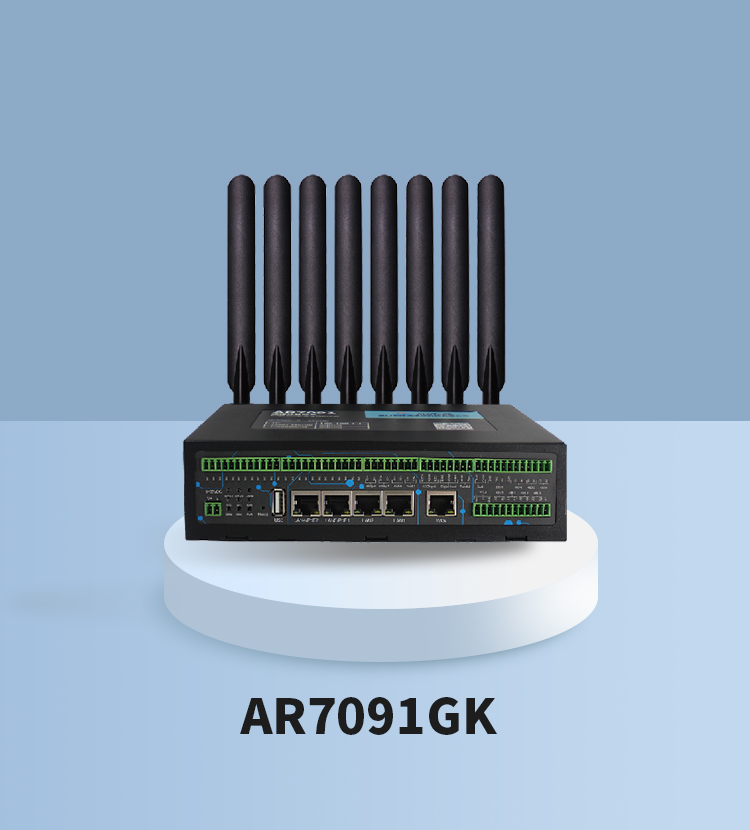
AR7091GK – Hydro-video RTU / Power-communication manager / Edge-computing gateway / CPE
Hardware
– Dual 5G modules, dual-SIM dual-stand-by
– 1× Gigabit WAN/SFP, 4× Gigabit LAN
– 1× rainfall input, 2× AI, 2× DI, 1× CAN, 2× relays, 2× controlled DC outputs
– 2× RS-232, 7× RS-485, 2.4 / 5 GHz high-speed Wi-Fi (Wi-Fi 6 optional)
– Optional GPS/Beidou, IRIG-B, power-sector encryption, eSIM
Software & Compliance
– Modular hardware/software architecture; I/O board can be user-defined
– Protocols: Hydrology 212, Water-Resources, Environmental 212, MQTT, Modbus RTU/TCP, OPC UA, NTRIP, DTU
– VPN suite: IPsec, L2TP, PPTP, OpenVPN, GRE, DMVPN
– PLC stacks: IEC 60870-5-101/104, DNP3.0, DL/T645, etc.
– Linux dual-core CPU, Python & C++ SDK for secondary development
Power & Environment
– 9 – 35 V DC; idle 5.9 W (4G) / 5.7 W (5G), transmit 6.5 W (4G) / 7.2 W (5G)
– Operating temperature –40 °C to +75 °C
– Dimensions 209 × 150 × 55 mm
System Advantages
1. Rich interface set – plug-and-play with legacy and modern instruments.
2. Open software stack – develop custom protocols or data-conversion routines on site.
3. Enterprise-grade VPN – ready for mission-critical power-utility and municipal networks.